How to Create a Home Inventory for Renters and Homeowners
A guide to Planning the Inventory and Understanding Your Policy, Photographing and Describing Every Area, Adding Receipts, Condition, and Valuation Notes, Securing the Files and Preparing Shareable Copies, Updating the Inventory and Using It After a Loss
A home inventory is a practical record of what you own, where it is, and which evidence supports it—not a guarantee of insurance coverage or a claim payment. Follow these 29 steps in our Home and Garden collection to build a searchable visual record, protect its sensitive details, and keep it useful after purchases, moves, or an insured loss.
How do you create a Home Inventory for Renters and Homeowners?
 Howcompass | How to Create a Home Inventory for Renters and Homeowners
Planning the Inventory and Understanding Your Policy
HowcompassDefine what the inventory must achieve
Define what the inventory needs to help you do. Use it to remember belongings, discuss personal-property coverage with an insurance professional, and organize evidence that may be requested after a loss, whether you rent or own your home. Include ordinary household contents as well as obvious valuables, and keep structural property, a landlord's belongings, and business property clearly separated when different policies or responsibilities apply. First-time renters can start from the live independently record list.
 Howcompass
Read the policy and list your questions
Read your current policy and prepare questions before documenting values. Identify the personal-property limit, deductible, covered causes of loss, exclusions, sublimits, and any scheduled items or endorsements, then ask your insurer or agent which records and valuation methods apply. Do not assume that every item, disaster, or full replacement amount is covered merely because it appears in your inventory. Keep the questions beside your personal budget notes.
 Howcompass
Choose a room-by-room record format
Choose a room-by-room structure and a consistent record format. Give each room or storage area a short code, then use the same fields for description, quantity, location, purchase details, model or serial number, evidence, and notes. The Triple-I home inventory brochure allows room-by-room, category, age, or value approaches and supports notebooks, photographs, video, or computer records, so select the method you can maintain rather than the most elaborate template. The same room order works when you childproof each room.
 Howcompass
Set up a spreadsheet and room index
Set up a simple spreadsheet and a plain-language room index. Create one row per significant item or defined group, reserve columns for uncertain dates and values rather than inventing precision, and add a contents page that links each room to its photos and receipts. Include an owner, last-review date, and version number so later updates do not get confused with the original pre-loss record. Keep the version note as clear as a weekly status update.
 Howcompass
Gather simple documentation tools
Gather basic documentation tools without buying specialized equipment. Prepare a phone or camera, charger, notebook, tape measure for useful dimensions, small labels kept outside the photographed item where appropriate, and a flashlight for cabinets or storage spaces. Check that you can open the resulting photos and spreadsheet on another device before spending hours creating files in an unfamiliar app. Clear storage on the shooting phone first, as refresh a sluggish phone explains.
 Howcompass
Build a protected folder structure
Create a protected folder structure and backup destination first. Separate original photos, working thumbnails, receipt scans, the editable inventory, and exported read-only copies, using names that will remain understandable outside the photo app. Our digital photo archiving guide covers this workflow, while Ready.gov financial preparedness recommends safeguarding identification, financial, legal, medical, and insurance records as part of disaster planning.
Photographing and Describing Every Area
 8Howcompass
Photograph wide views of each room
Begin each room with wide, clear overview photographs. Capture the walls, large furniture, visible electronics, open closets, and cabinet interiors from several angles without moving every object at once, then narrate useful details if you also record video. Ready.gov's citizen preparedness guide recommends photos or video of interior and exterior spaces, including closets and cabinet interiors, plus descriptions and model information.
 Howcompass
Add close-up photographs of valuables
Add closer photographs of valuable or difficult-to-describe items. Show identifying labels, materials, craftsmanship, dimensions, and relevant accessories while keeping the item in its normal context when possible, and connect each close-up to the room overview and spreadsheet row. Use safe handling and adequate light rather than moving heavy, fragile, or mounted objects merely for a better picture.
 Howcompass
Record models and serial numbers accurately
Record electronics and appliances with accurate model information. Photograph the manufacturer label and serial number where it can be read safely, note the screen size, capacity, attached components, and purchase details, and avoid tipping large appliances or reaching behind energized equipment in an unsafe way. Keep full identifiers in the private master inventory and use redacted versions when a recipient does not need them. Appliance care notes beyond the label are under home and garden guides.
 Howcompass
Document collections with supporting evidence
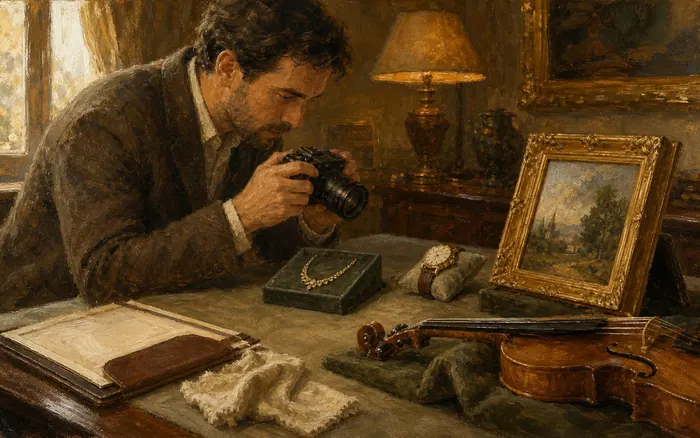
Document jewelry, art, instruments, and collections with their supporting evidence. Photograph individual high-value pieces and representative groups, include existing appraisals or provenance, and ask an insurance professional whether special limits or scheduling apply. Our archival collection storage guide can help preserve physical condition while you record the collection; avoid posting detailed valuables and location images publicly.
 Howcompass
Inventory garages, sheds, and outdoor gear
Include garages, sheds, balconies, storage units, and outdoor equipment. Record tools, bicycles, seasonal decorations, garden equipment, sports gear, spare furniture, and items lent to another household, noting the off-site address where relevant. Check inside drawers and storage boxes when safe, but do not climb, enter an unsafe structure, or expose sensitive documents to capture a complete-looking photograph. Planters and railings belong in the same balcony herb garden record.
 Howcompass
Write consistent descriptions and quantities
Write consistent descriptions and realistic quantities. Record brand, model, material, color, size, quantity, approximate purchase date and price where known, and use a defined group entry for low-value similar items such as books, cookware, or linens. Mark estimates and unknowns honestly, since a useful approximate record is better than precise-looking details invented for the spreadsheet. Mark guesses honestly with the habits of think critically and make decisions.
Adding Receipts, Condition, and Valuation Notes
 14Howcompass
Attach receipts, warranties, and appraisals
Attach receipts, warranties, appraisals, and provenance to the relevant item. Scan or photograph paper records legibly, save order confirmations from legitimate accounts, and link each document by filename or evidence field rather than burying it in an unsorted receipt folder. Preserve the original document when it has independent legal, warranty, tax, or appraisal importance.
 Howcompass
Restrict sensitive identifiers in the file
Keep sensitive identifiers and account details under tighter control. Capture serial numbers or policy references only where they serve ownership, warranty, recovery, or insurance purposes, and avoid placing bank card numbers, passwords, full identity numbers, or unrelated personal information in the general inventory. Redact order confirmations before sharing them when the address, payment, or account details exceed what the recipient needs. More privacy tooling is listed under computers and electronics guides.
 16Howcompass
Photograph existing wear and condition
Photograph current condition and notable existing wear honestly. Include scratches, repairs, modifications, and accessories when they affect identification or value, and date any updated images rather than replacing older evidence silently. An accurate pre-loss record is more credible and useful than presenting every item as new or concealing its history. Cabinet contents photograph better after you organize a small kitchen.
 17Howcompass
Separate purchase price from policy valuation
Distinguish purchase price from the policy's valuation approach. Ask how replacement cost and actual cash value apply to your contents, and avoid treating today's online listing, original price, sentimental value, or your own estimate as a guaranteed settlement amount. The NAIC disaster preparedness guidance explains that replacement cost does not deduct depreciation while actual cash value does, and recommends detailed records, photographs, and receipts. Treat an optimistic online valuation as a vet a claim you read online exercise.
 Howcompass
Flag items needing an appraisal or scheduling
Flag items that may need a professional appraisal or additional coverage. Review jewelry, fine art, antiques, high-end instruments, specialized equipment, and collections against policy sublimits and documentation requirements with a qualified insurance professional or appraiser. Record the appraisal date and scope, and repeat it when the market, condition, or policy requirements change rather than assuming one valuation lasts forever. Professional advice options are gathered under finance and business guides.
Securing the Files and Preparing Shareable Copies
 19Howcompass
Finish the index and readme for other readers
Finish the index so every item can be found without you. Sort rows by room and description, check that photo and receipt links open, and add a short readme explaining the naming system, version, and who owns the inventory. Use plain-text or widely supported export formats alongside any proprietary app so access does not depend on one subscription or device. Order the folder the way you would pass border control paperwork.
 Howcompass
Keep encrypted backups in separate locations
Keep encrypted backups in more than one safe location. Preserve the master inventory, original evidence, and exports with independent off-site or cloud protection and an offline copy, then test that another authorized device can open them. Our encrypted cloud and local backup guide provides a detailed setup, and storing the only inventory beside the belongings it documents leaves both vulnerable to the same event.
 21Howcompass
Lock down accounts and devices holding the file
Protect the master inventory with strong account and device security. Limit access to authorized household members, enable multi-factor authentication, and review shared links or exported files that contain a complete view of valuables, serial numbers, and the home address. Our password manager and recovery guide can help secure the account and its recovery route without placing passwords in the inventory itself.
 22Howcompass
Prepare a redacted insurer-ready copy
Create a concise insurer-ready copy with only necessary information. Include the inventory version and date, item descriptions, quantities, relevant valuation notes, and supporting evidence requested through the insurer's official process, while redacting unrelated identity, payment, and account details. FEMA's critical documents checklist includes housing records, insurance policies, appraisals, photographs, and lists of valuable items among records worth safeguarding. Redact as carefully as you would when you check your credit reports.
 23Howcompass
Store an emergency-access summary and instructions
Store a small emergency-access copy and clear retrieval instructions. Keep a printed room index or essential summary in a protected emergency-records location, note where the full digital master and backups are stored, and authorize a trusted person through appropriate account or legal processes if needed. Do not print the entire sensitive inventory for casual storage or give a helper your everyday password merely to make access easier.
Updating the Inventory and Using It After a Loss
 Howcompass
Log new purchases while details are fresh
Add significant purchases, gifts, and disposals while details are fresh. Save the receipt, photograph the item and model label, update quantities or room locations, and mark replaced or sold items with a date instead of deleting every trace blindly. A few minutes after a major purchase prevents another intimidating whole-home project later. Fit the purchase inside your monthly savings plan so the records agree.
 Howcompass
Review one room monthly, everything annually
Review one room each month and the whole index annually. Compare the contents with the overview images, check uncertain descriptions and broken evidence links, and record only the changes since the last version. Rotate through storage spaces as well as visible rooms, and keep the review small enough that it actually happens.
 Howcompass
Update the record after a move or renovation
Rebuild location details after a move, renovation, or major reorganization. Photograph the new rooms before unpacking when useful, update item locations and off-site storage, and preserve the prior inventory version as a historical record. Check that the policy address, household contacts, and any security or property changes have been communicated through the appropriate official channels. Repair the walls afterwards with patch holes and cracks guidance.
 Howcompass
Discuss coverage at the annual policy review
Discuss coverage during an annual policy review rather than waiting for a claim. Share appropriate totals or high-value information with your insurance professional, ask about changed replacement costs, sublimits, exclusions, deductibles, and documentation requirements, and update the policy questions in your notes. Our emergency-fund guide complements this review by helping you plan for deductibles and immediate expenses, but the fund and insurance should not be treated as interchangeable.
28HowcompassTest access from another authorized device
Test restoration and household access before an emergency. Open the spreadsheet, exports, photographs, and receipt folder from a different authorized device, verify backup dates, and ask the intended emergency contact whether the retrieval instructions are understandable. Correct expired accounts, lost recovery methods, and unreadable files while the original evidence is still available. Try the weakest signal spot where whole home Wi-Fi coverage is poorest.
 Howcompass
Document damage safely after a loss
After a loss, prioritize safety and document damage according to official instructions. Enter only when authorities and the property condition allow, photograph affected rooms and items without disturbing evidence unnecessarily, and contact the insurer promptly for claim and mitigation requirements. Do not discard damaged property, begin major repairs, or sign broad releases before understanding the insurer's instructions, except where immediate action is required for health, safety, or preventing further damage. Use the same re-entry caution as your home fire escape plan.
 Howcompass
Keep a claim log and preserve the original record
Keep a claim log and preserve the untouched pre-loss inventory. Record official contacts, claim numbers, dates, requested documents, mitigation work, expenses, and copies of what you submitted, then add post-loss evidence as a new version rather than editing the original record. Follow deadlines and requests from the insurer or relevant authorities, and seek qualified local advice for coverage, legal, tax, or valuation disputes. Cover immediate costs from an emergency cash fund while the claim settles.
Frequently Asked Questions
Question: Do renters need a home inventory?
Yes. Renters can use it to document their own belongings and discuss renters insurance, while keeping the landlord's structure and property separate. Coverage and documentation requirements depend on the policy and jurisdiction.
Question: Must I list every spoon, book, and sock individually?
Not usually. Record significant items separately and use clearly defined quantity groups for similar low-value belongings, with representative photos and honest estimates. Ask your insurer whether a particular category needs more detail.
Question: How often should a home inventory be updated?
Add major purchases, disposals, moves, and appraisal changes promptly, then perform a full review at least annually. Regular small room checks make the annual task much easier.
Question: Do I really have to photograph every plate and t-shirt?
No. Group low-value duplicates into one defined entry, such as twelve dinner plates or a wardrobe of work shirts, and photograph that group once with the quantity noted. Reserve individual close-ups for items above your policy's ordinary limits or anything you expect to claim for. A coarse record you actually maintain beats an exhaustive one you abandon after the kitchen.
Tips
- Photograph one room completely before starting another; a finished small section is more useful than dozens of disconnected close-ups.
- Use a consistent room code in every filename and spreadsheet row so overview photos, item details, and receipts can be matched quickly.
- Keep both an editable master and a dated read-only export so later updates never overwrite the evidence you might need after a loss.
Warnings
- An inventory does not itself prove that every item or disaster is covered or guarantee a settlement amount; policy terms, limits, deductibles, depreciation, and required evidence still apply.
- Protect the full inventory because room images, addresses, serial numbers, valuables, and document scans can create security and identity risks when shared broadly.
- After a fire, flood, structural damage, or other disaster, do not enter or handle hazardous property for photographs until the relevant authorities say it is safe.
Things You'll Need
- A phone or camera with sufficient storage and power
- A room-by-room spreadsheet and plain-language index
- Receipts, warranties, appraisals, and relevant policy documents
- A notebook, flashlight, and optional measuring tape
- Encrypted off-site and offline backup storage
- A protected location for the emergency-access summary and recovery instructions
Try it with a free tool
You have read the method — now work through your own numbers or text. These free tools run in your browser, need no sign-up and link back to this guide.
Related Howcompass Guides


References (5)
- Brochure: Home InventoryInsurance Information Institute
- Financial PreparednessReady.gov
- Are You Ready? An In-Depth Guide to Citizen PreparednessFEMA / Ready.gov
- Consumer Insight: Disaster PreparednessNational Association of Insurance Commissioners
- Safeguard Critical Documents and ValuablesFEMA / Ready.gov
Sources are listed so you can read the underlying guidance yourself. Our editorial policy explains how guides are reviewed.
Did this article help you?
0 readers found this helpful — add your vote.
No comments yet — be the first to share your results.