How to Create a Family Emergency Communication Plan and Contact Card
A guide to Collecting Contacts and Choosing Meeting Places, Deciding How Everyone Will Communicate, Preparing Offline Contact Tools and Power, Practicing the Plan as a Household, Keeping the Plan Current and Usable
An emergency communication plan should work when household members are separated and normal routines are interrupted. Use these 22 steps in our Family Life collection to collect essential contacts, choose realistic meeting arrangements, prepare offline tools, and practice without using emergency services.
How do you create a Family Emergency Communication Plan and Contact Card?
 Howcompass | How to Create a Family Emergency Communication Plan and Contact Card
Collecting Contacts and Choosing Meeting Places
HowcompassBring the household together and list members
Bring the household together and identify who belongs in the plan. Include children, relatives, roommates, caregivers, and people who may be away at work, school, or travel, then ask an out-of-area friend or relative to serve as a central contact. The FEMA family communication card provides fields for household information, an out-of-town contact, and emergency meeting places. Keep that distant contact warm with long-distance friendship habits.
 Howcompass
Collect contacts and individual access needs
Collect essential contact details and individual access needs. Record mobile and alternative numbers, email addresses, schools, workplaces, caregivers, medical facilities, and local emergency contacts, while noting communication, mobility, sensory, language, medication, or equipment needs only where they affect the plan. Ask permission before sharing sensitive information and provide large-print, spoken, or other accessible formats as needed. Medication and equipment notes follow care for an ageing parent routines.
 Howcompass
Make a wallet card for each person
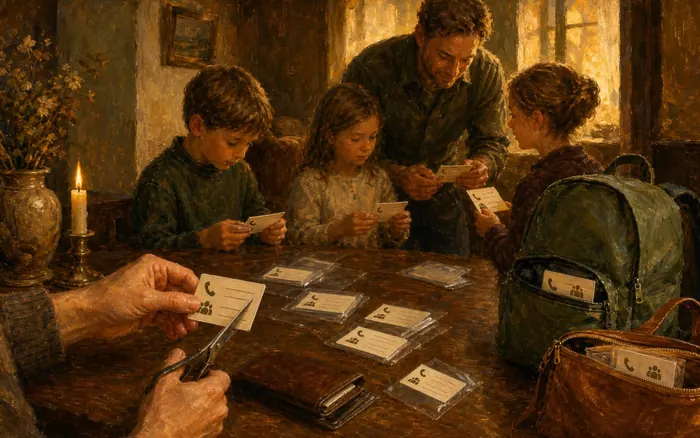
Make a durable wallet-sized contact card for every person. Include the household's essential numbers, the out-of-area contact, chosen meeting locations, and any brief instruction needed to reach a responsible adult, using legible print and water-resistant protection where practical. Keep cards in backpacks, wallets, purses, and emergency kits, and place a larger copy in a central home location without displaying private details to casual visitors.
 Howcompass
Choose meeting places at three distances
Choose safe meeting places at increasing distances from home. Identify a familiar neighborhood location for a sudden evacuation, another outside the neighborhood if you cannot return, and an out-of-town option for a wider disruption, checking accessibility, opening hours, pets, and transport realistically. The Red Cross emergency-plan guidance recommends meeting places immediately outside the home and outside the neighborhood, plus an out-of-area contact.
 Howcompass
Walk the routes before you need them
Discuss routes and transport before anyone needs to use them. Walk or review the safest practical paths to each location, identify alternatives for road closures or public-transport disruption, and decide who can assist children, older adults, disabled people, or anyone without a car. Make clear that official instructions and actual hazards take priority over reaching a preselected point, and never expect someone to travel through danger merely to complete the plan. Children cycling alone learn the same route rules in riding in city traffic.
Deciding How Everyone Will Communicate
 Howcompass
Set a check-in order and message method
Set a simple check-in order and preferred message method. Decide who attempts contact first, which group list to use, and when to switch from a call to a short text, email, or another available service because networks may be congested or inaccessible. Keep the sequence easy enough for every participant to remember, and avoid repeatedly calling someone who may need to focus on immediate safety. Your power outage plan should name which channel still works when masts fail.
 Howcompass
Use the out-of-area contact as a relay
Use the out-of-area contact as a relay rather than a substitute for local emergency help. Ask each separated person to send their safety status and location to that contact when practical, and let the contact share updates without promising rescue or resources they cannot provide. Ready.gov's citizen preparedness guide recommends an out-of-state point of contact with at least two forms of contact in case local communication is unavailable. Write the relay instructions as plainly as an email that gets a reply.
 Howcompass
Coordinate with schools and workplaces
Coordinate with schools, childcare, workplaces, and caregivers. Learn their release and notification procedures, record authorized pickup people, and make sure children know to follow a responsible adult's instructions rather than leaving alone to find family. Include household members living elsewhere during part of the year and agree on how the plan changes when they are home or away.
 Howcompass
Add pets and service animals to the plan
Include pets and service animals in the communication arrangements. Assign who will collect and transport each animal, list backup caregivers, veterinarians, boarding options, and animal-friendly accommodation, and keep a current photo and identification details available. Ready.gov pet preparedness emphasizes including animals in emergency plans; our new puppy or kitten guide can support the wider care routine, but shelter rules should always be checked in advance.
 Howcompass
Agree on a private short message format
Agree on a short message format that protects privacy. Include your name, whether you are safe, your general location, immediate needs, and your next intended action, such as a brief status text that can be understood without a long conversation. Share only necessary information through the expected channel, and never publish addresses, medical details, or children's whereabouts publicly to prove that you are safe. Device privacy habits are collected under computers and electronics guides.
Preparing Offline Contact Tools and Power
 Howcompass
Save contacts beyond a locked device
Save essential contacts and instructions for offline use. Add the household group and a clearly identified emergency contact to phones where appropriate, download or print the plan, and make sure a locked device does not become the only place the information exists. Teach children without phones which responsible adult and paper card to use instead of requiring them to remember every number. Clear space for the offline copy with refresh a sluggish phone steps.
 Howcompass
Prepare power and radios for outages
Prepare power and receiving equipment for likely local disruptions. Keep charged power banks, suitable cables, a battery or hand-crank radio where appropriate, and fresh spare batteries with the household kit, checking them on a regular schedule. Ready.gov power-outage guidance covers preparing for outages, and our car emergency kit guide can help coordinate vehicle supplies without making the car your only communication resource.
 Howcompass
Keep addresses and maps available offline
Keep addresses and route information available without a network connection. Print the meeting-place addresses and local maps, save relevant offline map areas, and include transport contacts or accessible-transit information that household members actually use. Our offline topographic map guide explains phone preparation, but paper remains useful when batteries fail or a device is lost.
 15Howcompass
Store copies in several secure places
Store copies in several secure and accessible places. Put the contact card and a concise plan in emergency kits, school or work bags, and the central household location, and keep a protected digital copy with appropriate access for authorized adults. Our encrypted backup guide can protect the digital version, while public or shared copies should omit unnecessary medical, account, and identity details.
Practicing the Plan as a Household
 16Howcompass
Run a short separation drill
Run a short drill based on a realistic separation scenario. Imagine that school and work have ended at different times, mobile service is unreliable, or the neighborhood meeting place is unavailable, then ask each person what they would do first and which backup they would use. Our family routine guide offers a useful way to make practice calm and recurring rather than frightening.
 Howcompass
Practice real messages and meeting walks
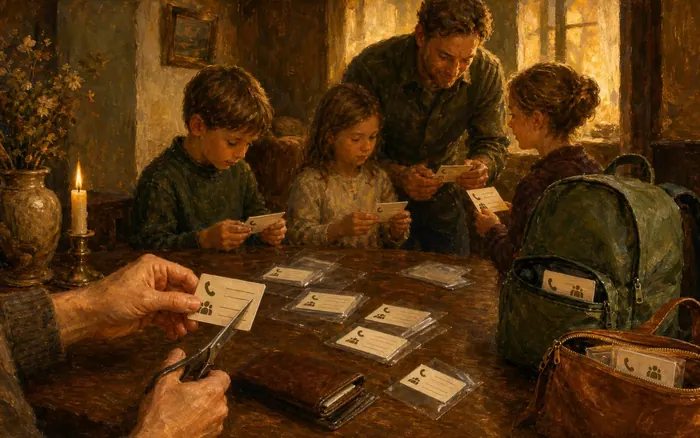
Practice the actual message and meeting actions safely. Send a test text to the household group and out-of-area contact, locate the paper card, and walk to a safe neighborhood meeting point together during ordinary conditions. Never call emergency services as a test, create a false public alert, or ask children to travel unsupervised for the sake of realism. More low-key household practice ideas sit under family life guides.
 Howcompass
Rehearse each person's own role
Let children, caregivers, and support-network members rehearse their own roles. Ask a child to explain which adult to approach, have a caregiver confirm pickup arrangements, and let anyone with access needs choose the communication and transport method that works for them. Listen for confusion and adjust the plan rather than treating a perfect recitation as the only measure of readiness. Point children at the exits you checked when you childproof each room.
 Howcompass
Fix one weak point after each drill
Review the drill and fix one weak point at a time. Note dead batteries, missing numbers, unclear meeting instructions, inaccessible routes, or someone who did not receive the test message, then assign an owner and a realistic date for each correction. Repeat only the part that failed so the plan becomes easier to use without turning every rehearsal into a major exercise. Log each correction like a weekly status update action item.
Keeping the Plan Current and Usable
 Howcompass
Review contact details every year
Review contact details at least annually and whenever circumstances change. Update new phones, schools, jobs, caregivers, addresses, out-of-area contacts, accessibility needs, and pet arrangements immediately rather than waiting for the next scheduled review. Replace damaged cards and remove obsolete copies that could send someone to the wrong person or place. Refresh the printed set during your yearly home inventory update.
 21Howcompass
Match the plan to local procedures
Check that your plan still matches school, workplace, building, and local procedures. Compare notification channels, release rules, shelter or evacuation instructions, and transportation options with the organizations you may depend on, using their official current information. The household plan should complement those procedures rather than instructing anyone to ignore them. Ask your manager for the same rules in a weekly one-to-one.
 Howcompass
Adapt the plan for travel and visitors
Adapt the plan for travel, visitors, and temporary household changes. Tell guests where the household contact card and basic instructions are kept, carry essential contacts and addresses when away, and decide how a student, deployed relative, or frequent traveler will check in from another location. Keep temporary additions limited to what the person needs and remove access afterward when appropriate.
 Howcompass
Hold an after-action review after a real incident
Use a real incident as a careful after-action review. Once everyone is safe, record which messages arrived, which meeting or transport choices worked, and where information or supplies were missing, then update the cards and backup copies together. Preserve privacy and avoid blame; the purpose is to make the next response clearer, not to criticize anyone for decisions made under pressure. Keep the lessons in a weekly values journal so they survive the year.
Frequently Asked Questions
Question: Why use an out-of-area contact?
A person outside the affected area can act as a central relay when household members cannot reach one another locally. It is not guaranteed that long-distance communication will work, so keep multiple contact methods and local meeting arrangements as well.
Question: What if a child does not have a phone?
Provide a readable contact card and teach the child which responsible adults to follow and how to ask for help. Coordinate authorized pickup and emergency contact details with the school or caregiver instead of relying on the child's memory alone.
Question: How often should we practice and update the plan?
Review it at least once a year and whenever contact details, household members, schools, work, access needs, or meeting places change. Short occasional drills help reveal missing numbers, dead batteries, and unclear instructions before a real disruption.
Question: Our household speaks different languages and one person has no smartphone. Does the plan still work?
Yes, as long as every member gets the same information in a format they can use. Print the card in each home language, record a spoken version for anyone who prefers audio, and give the phone-free person a paper card plus one named responsible adult to approach. Rehearse the wording out loud during a drill, because recognising a phrase is easier under stress than translating one.
Tips
- Keep the wallet card short enough to read under stress, with the out-of-area contact and meeting places easiest to find.
- Use a calendar reminder around an existing household event to review numbers, batteries, and meeting places together.
- Let each household member practice sending the same brief safety-status message so no one has to compose a format for the first time during an emergency.
Warnings
- Never call emergency services for a drill; use the local emergency number only for a genuine emergency according to local guidance.
- Do not delay evacuation or other official safety instructions to retrieve a phone, contact card, pet supplies, or any other belongings.
- Protect children's locations, medical details, home addresses, and other private information when storing or sharing the plan.
Things You'll Need
- A household contact and access-needs list
- An agreed out-of-area contact
- Wallet-sized cards and a central home copy
- Paper maps and downloaded offline route information
- Charged power banks, suitable cables, and a radio where appropriate
- Copies for emergency kits, school or work bags, and secure digital storage
Related Howcompass Guides




References (5)
- Family Emergency Communication Plan — Fillable CardFEMA / Ready.gov
- How to Make Your Emergency PlanAmerican Red Cross
- Are You Ready? An In-Depth Guide to Citizen PreparednessFEMA / Ready.gov
- Plan Ahead for Your PetsReady.gov
- Power OutagesReady.gov
Sources are listed so you can read the underlying guidance yourself. Our editorial policy explains how guides are reviewed.
Did this article help you?
0 readers found this helpful — add your vote.
No comments yet — be the first to share your results.