How to Read a Prescription Medicine Label and Organize a Safe Dosing Schedule
A guide to Verifying the Prescription and Instructions, Building an Accurate Medication List and Schedule, Measuring and Taking Medicines Exactly as Directed, Storing and Securing Medicines, Reviewing Changes and Preventing Future Errors
A prescription label is tailored to one person and one treatment plan; a familiar bottle, an old schedule, or another patient's directions can still lead to a medication error. Use these 23 steps in our Health collection to read the label with the pharmacist's supporting information, organize reminders, and ask for medication-specific guidance rather than changing a dose, stopping abruptly, or improvising a missed-dose rule.
Read the label against the pharmacy's instructions: your name, medicine and strength, dose, route, frequency and duration. Build one complete medication list including over-the-counter products and supplements, set reminders, and use the measuring device supplied rather than a kitchen spoon. Ask the pharmacist about missed doses, splitting, storage and interactions; never change a dose on your own.
- Time
- 15–30 minutes to set up; 5 minutes per refill
- Cost
- Free–$30 for a pill organizer
- Difficulty
- Moderate — high stakes
- People
- 1 plus a pharmacist
- Space
- A well-lit table
- Tools
- Label and leaflet, medication list, pill organizer, measuring device
How do you read a Prescription Medicine Label and Organize a Safe Dosing Schedule?
 Howcompass | How to Read a Prescription Medicine Label and Organize a Safe Dosing Schedule
Verifying the Prescription and Instructions
HowcompassCheck the label before leaving the counter
Read the prescription label in good light before leaving the pharmacy or using the medicine. Confirm that the container belongs to the intended person and that it contains the expected medicine, then keep it in the original labeled packaging. FDA's Medicines in My Home guide describes checking the right medicine, person, amount, time, and method, so use the label every time rather than relying on memory or a bottle's familiar appearance. Resisting a familiar-looking bottle is ordinary verification practice, covered in making well-reasoned decisions.
 Howcompass
Confirm patient, prescriber, and prescription details
Verify the patient name, prescriber, pharmacy contact details, prescription number, and refill information. Check that these details match the current prescription and any new instructions from the clinician, and ask the pharmacy to correct a discrepancy before the medicine is taken. Keep the label and medication list private because they contain health and contact information, but make the pharmacy number available to authorized caregivers who may need to clarify directions. Challenging a document error at its source is the same procedure as disputing credit report errors.
 Howcompass
Match the name, strength, and appearance
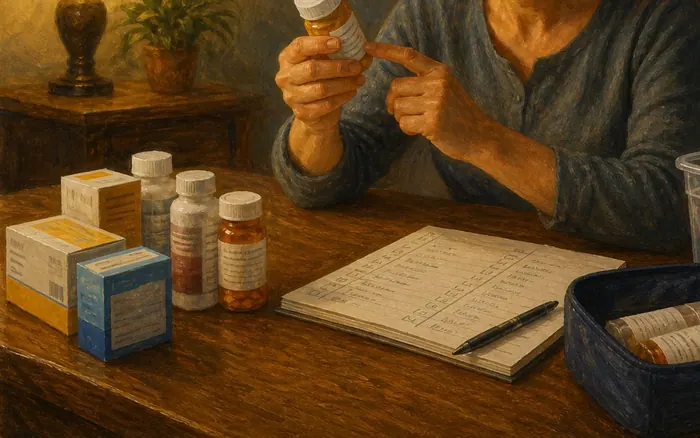
Identify the brand or generic name, strength, dosage form, purpose, and expected appearance of the medicine. Read the name and strength together so a similar-sounding product or a different concentration is not substituted in your schedule, and ask the pharmacist to explain the medicine's appearance and intended use. If a refill looks different, do not assume it is wrong or automatically equivalent; verify the manufacturer change and instructions with the pharmacist before taking it. If the explanation you receive is unclear, resolve the conversation respectfully before you leave.
 Howcompass
Copy the directions word for word
Transcribe the directions exactly, including the amount, route, frequency, timing, duration, and food instructions. Distinguish scheduled use from “as needed,” note any maximum or special directions, and ask what vague terms mean in your daily routine instead of inventing a schedule. FDA's Medicines and You guide recommends asking how and when to take a medicine, whether doses belong before, during, or after meals, and what “four times a day” or “as needed” means for that prescription. A written query to the pharmacy works better when it asks one precise thing, as our email guide explains.
 Howcompass
Read the leaflets beside the container label
Read auxiliary labels, patient leaflets, Medication Guides, and monitoring instructions together with the container label. Note allergy warnings, interactions, foods or activities to avoid, possible side effects, and any required tests, then ask the pharmacist which points apply to your other medicines and supplements. FDA's Think It Through guide recommends knowing the benefits, risks, interactions, storage, missed-dose instructions, and monitoring needs rather than treating the small direction line as the complete safety plan. The same fine-print habit is taught for other documents in reading a payslip.
Building an Accurate Medication List and Schedule
 Howcompass
List every medicine you actually take
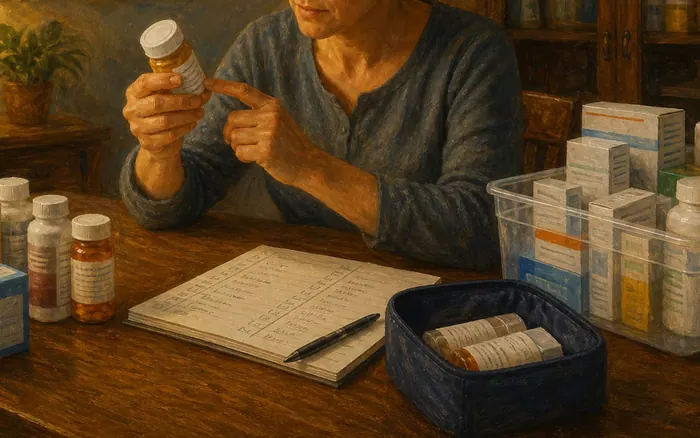
Create one complete medication list that includes prescriptions, over-the-counter products, vitamins, herbal products, and supplements. Record each name, strength, amount, schedule, purpose, prescriber, start date, and any allergies or previous problems, and keep both a home copy and an accessible copy for appointments. MedlinePlus medication-error guidance recommends a comprehensive list and sharing it with every health-care provider so duplicate ingredients and interactions can be reviewed. For recurring aches, cold and heat therapy can reduce how many products belong on that list.
 Howcompass
Turn the directions into a daily timetable
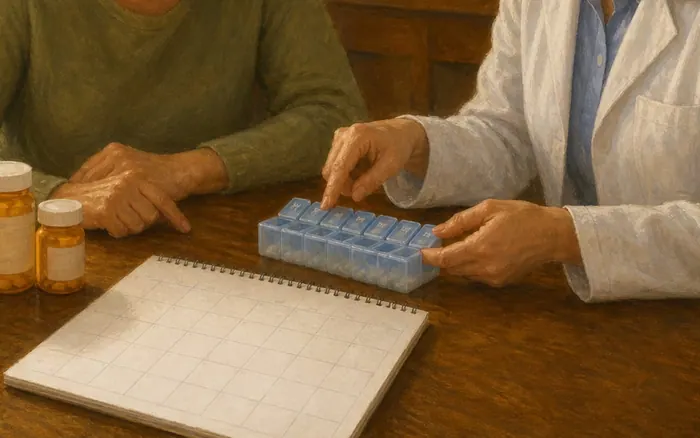
Convert the confirmed directions into a written daily schedule with the prescriber or pharmacist when the timing is unclear. Place doses around waking, meals, bedtime, work, and other medicines only as the instructions permit, and ask about spacing, time zones, or a changed routine rather than assuming evenly spaced doses are required. Keep the original directions beside the schedule so a shorthand entry such as “morning” cannot silently replace a more specific food, route, or timing requirement. Writing a schedule other people must follow literally is the skill in a clear weekly status update.
 Howcompass
Ask before using a pill organizer
Use a pill organizer only after confirming that each medicine and storage requirement is suitable for it. Ask the pharmacist which products can be removed from their original containers, prepare one scheduled period at a time in good light, and never combine different medicines in an unmarked bottle or compartment. FDA's Medicines and You guide supports calendars and pill boxes as reminders, but original containers remain essential for identifying instructions, refills, expiration dates, and medicines that require special storage. Our home first-aid kit guide sets out which supplies stay in their own packaging.
 Howcompass
Set reminders that prevent double doses
Set reminders and caregiver handoffs that reduce rather than duplicate doses. Use a calendar, alarm, or medication log to mark a dose only after it is taken, define who is responsible for giving it, and tell authorized caregivers where the current schedule is kept. FDA's Medicines and You guide includes charts, calendars, timers, and smartphone apps as useful prompts, but a shared household should treat an unchecked alarm as a prompt to verify, not a reason for two people to give the same dose. The mark-after-you-finish habit is exactly what a useful home log is designed to enforce.
 Howcompass
Sort out refills and travel in advance
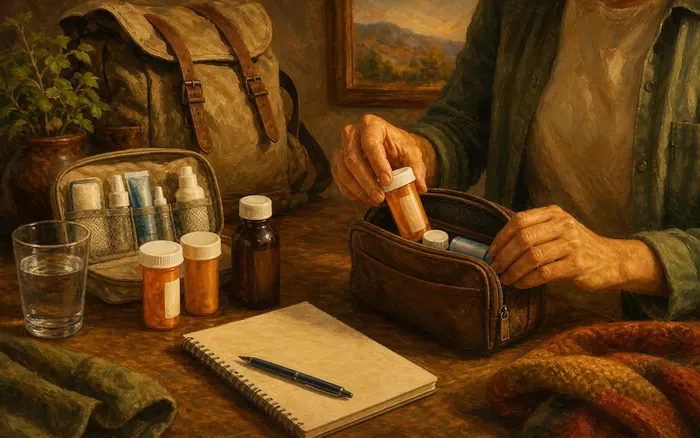
Plan refills, travel, and routine changes before the current supply runs out. Check refill dates, carry medicines in original labeled containers with the clinician and pharmacy contacts, and ask how to adjust a schedule for time zones, meals, or an overnight trip; keep required storage conditions during transit and avoid leaving medicines in a hot or freezing vehicle. FDA's Medicines and You guide recommends early refills and asking a professional about travel-related schedule changes. For time-zone shifts, resetting jet lag shows how to move the day's anchors gradually.
Measuring and Taking Medicines Exactly as Directed
 Howcompass
Use the dosing device supplied with the bottle
Measure liquid medicine with the dosing syringe, cup, or spoon supplied for that product. Read the marking at the instructed unit, such as milliliters, ask the pharmacy for a suitable device if none was provided, and never substitute a kitchen teaspoon or estimate a fraction by eye. FDA's Medicines in My Home guide explains that ordinary eating and cooking spoons can hold the wrong amount and that the measuring tool must match the prescribed dose. Real measuring tools in a small kitchen are the only spoons and cups worth trusting.
 Howcompass
Get approval before crushing or splitting tablets
Check with a pharmacist before splitting, crushing, chewing, opening, or dissolving a tablet or capsule. A score line, a previous formulation, or difficulty swallowing does not automatically make alteration safe, and changing a modified-release or coated product can alter how the medicine works. FDA's Medicines and You guide explicitly says not to break, crush, or chew tablets without first asking a health professional; ask about suitable alternatives instead of improvising. Inferring mechanism from appearance is precisely the error warned about in reading a research paper.
 Howcompass
Rehearse the technique for devices and patches
Demonstrate the required technique for inhalers, injections, patches, drops, topical products, or other special dosage forms with a qualified professional. Confirm preparation, site, timing, disposal, and whether the product can be shared equipment or must remain single-person use, and practice only within your training and the manufacturer's instructions. Do not reuse needles, apply a patch to damaged skin, or improvise a route because the written direction is difficult; ask the prescriber or pharmacist for a demonstration and a safe alternative when needed. More device and self-care walkthroughs live in the health category.
 Howcompass
Write the missed-dose rule in advance
Ask in advance what to do about a missed dose, vomiting after a dose, or a suspected side effect. Write the medication-specific answer on the schedule, and do not double a later dose, take an extra amount, or stop a prescription abruptly unless the prescriber's instructions specifically direct that action. FDA's Medicines and You guide recommends asking about missed doses and warns against abrupt discontinuation or self-adjusted dose changes, so contact the clinician or pharmacist when the situation is not covered. Deciding the response before the event is the same principle behind a practised fire escape plan.
 Howcompass
Log effects and know when to escalate
Record the medicine's effects and any new symptoms, and seek the appropriate level of help. Note the dose time, symptom onset, and other products taken so the clinician or pharmacist can assess the problem, and call emergency services for severe or rapidly worsening symptoms. In the United States, HRSA Poison Help is 1-800-222-1222 for immediate poison-center guidance; use the local poison service elsewhere and do not wait for symptoms after a significant accidental exposure. Judging severity at home, including when to stop and call for help, is set out in caring for a minor cut.
Storing and Securing Medicines
 Howcompass
Store each product where its label says
Follow each product's storage label instead of using one location for every medicine. Keep products within their specified temperature and moisture conditions, refrigerate only when directed, and avoid damp bathrooms, hot appliances, sinks, direct sunlight, and vehicles unless the instructions explicitly permit them. FDA's medicine-storage guidance explains that improper storage can reduce effectiveness even before expiration, and our power-outage guide explains why refrigerated medicines need a medication-specific backup plan.
 Howcompass
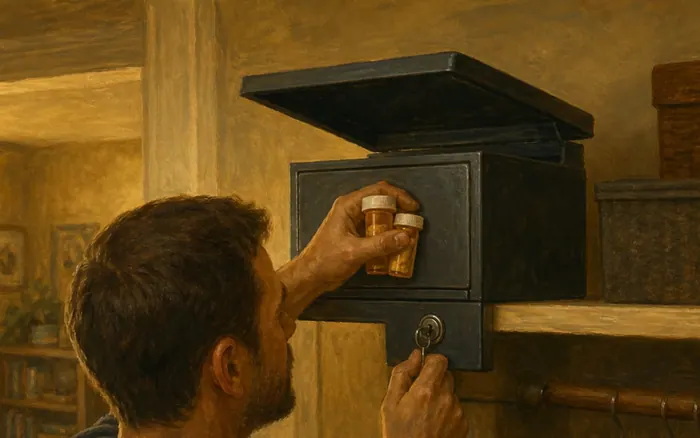
Lock medicines away from children and pets
Keep every medicine out of sight and reach of children and pets, and use locked storage when additional protection is needed. Secure controlled medicines and products that could be dangerous in small amounts, close child-resistant caps correctly, and account for visitors, purses, luggage, and pill organizers that may be easier to open. MedlinePlus medication-error prevention and FDA storage guidance emphasize preventing access by children and others for whom the medicine was not prescribed. Work room by room with the same checklist used to childproof your home.
 Howcompass
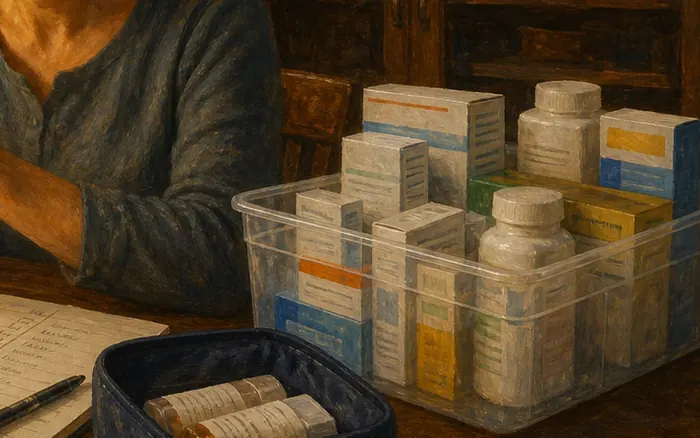
Discard anything expired or unidentifiable
Check expiration dates, container integrity, and any unexpected change in the medicine before use. Remove expired, damaged, unidentified, or improperly stored products from the active schedule and ask a pharmacist about replacement or safe handling rather than tasting, smelling, or assuming a full bottle is still effective. FDA expiration guidance states that expired medicines can be less effective or risky and that safety and effectiveness are no longer guaranteed after the printed date. A dated home inventory makes the same culling habit easy to repeat.
 Howcompass
Take unused medicines to an authorized drop-off
Dispose of unneeded medicines through an authorized take-back location or prepaid mail-back option whenever available. Follow the product's specific instructions and the FDA medicine-disposal guide, and do not flush a medicine unless current FDA instructions specifically recommend it for that product when take-back is not readily available. Keep disposal containers away from children and pets, and use the detailed safety boundaries in our home first-aid kit guide when updating household supplies.
Reviewing Changes and Preventing Future Errors
 Howcompass
Update the list after every care change
Reconcile the medication list after every new prescription, clinic visit, hospital discharge, or pharmacy change. Compare the new directions with the previous list, ask which products should be started, stopped, replaced, or continued, and update the schedule only after the clinician or pharmacist resolves discrepancies. FDA's Think It Through guide emphasizes knowing when and under what conditions to stop or change a medicine rather than making an independent substitution. Comparing a new statement against your own record line by line is the method of reconciling a bank statement.
 Howcompass
Book a full medication review
Schedule a comprehensive medication review with a pharmacist or clinician, including nonprescription products and supplements. Bring original containers and the current list, ask about duplicate ingredients, interactions, unnecessary complexity, monitoring, affordability, and whether the schedule still matches your health needs, and use one pharmacy when practical so the complete picture is easier to assess. FDA's Medicines and You guide recommends a regular medicine check-up and sharing the full product list. Raise cost at the same appointment; saving money every month covers the budget conversation around regular expenses.
 Howcompass
Keep the list ready for caregivers
Keep the current medication and allergy list accessible for emergencies and authorized caregivers. Store a copy with essential health contacts, carry another copy when away from home, and share only the information needed for safe care while protecting the list from casual disclosure. MedlinePlus medication-error guidance recommends taking the list to every health-care visit, and an accessible current copy can help responders avoid duplicating or interrupting important treatment. Sharing health records with hired help is one of the tasks in caring for an ageing parent.
 Howcompass
Re-review the schedule whenever anything changes
Review the entire schedule whenever a label, dose, health condition, routine, or caregiver changes. Replace old printouts, confirm reminders and refills, remove discontinued products from active storage only after professional confirmation, and record any new symptoms or questions for the next review. Finish by checking that the original containers, current list, and emergency contacts agree, because an accurate schedule is a living record rather than a one-time transcription of the first prescription. A fixed diary slot for that check is the arrangement behind a weekly review journal.
How to know it worked
- Name, medicine, strength, dose and timing all match the pharmacy label.
- One complete medication list includes supplements and over-the-counter products.
- The supplied measuring device is used for liquids.
- A pharmacist has reviewed interactions and missed-dose rules.
Common mistakes to avoid
- Assuming a familiar bottle still holds the same strength.
- Using a kitchen spoon for liquid medicine.
- Keeping an incomplete list that omits supplements.
- Splitting or crushing a tablet without checking.
- Improvising a missed-dose rule instead of asking.
- Storing medicines in the bathroom or within reach of children and pets.
Frequently Asked Questions
Question: What should I do if I miss a dose?
Use the missed-dose instructions for that specific prescription, or ask the prescriber or pharmacist if they are unclear. There is no safe universal rule. Do not double a later dose or take an extra amount unless the medication-specific directions explicitly tell you to do so.
Question: Does “twice daily” mean exactly every 12 hours?
Not necessarily for every medicine. The correct spacing can depend on the drug, formulation, meals, other medicines, and your routine. Ask the prescriber or pharmacist to translate the label into a practical schedule, and write down their medication-specific answer rather than assuming.
Question: Can I put every medicine in a weekly pill organizer?
Not always. Some products have storage, moisture, identification, or handling requirements that make an organizer unsuitable. Ask the pharmacist which medicines can be included, keep original containers and labels, and never mix different products in an unmarked container.
Question: Should all medicines be refrigerated or kept in the bathroom cabinet?
No. Refrigerate only when the label or pharmacist directs it, and avoid damp bathroom storage unless the product instructions permit it. Follow each medicine's temperature and moisture requirements, protect it from children and pets, and do not use expired medicine.
Tips
- Keep the pharmacy label, patient leaflet, and current schedule together so warnings and special instructions are not separated from the daily reminders.
- Ask the pharmacist for larger-print labels or a demonstration when reading or technique is a barrier, and bring an authorized caregiver to the review if helpful.
- Mark a dose on a shared log only after it is taken; this makes caregiver handoffs clearer than relying on memory or repeated alarms.
- Use one complete list for prescriptions, OTC products, vitamins, and supplements rather than maintaining separate lists that hide duplicate ingredients.
Warnings
- Never take another person's prescription, share your own, double a missed dose, or stop or change a prescription abruptly without medication-specific professional guidance.
- Do not split, crush, chew, open, or dissolve a tablet or capsule unless a pharmacist or prescriber confirms that the specific product can be altered safely.
- Do not use a kitchen spoon for liquid medicine or combine unidentified medicines in one container; use the correct dosing device and original labeled packaging.
- Call emergency services for severe symptoms and contact Poison Help immediately after a significant accidental exposure; do not wait for symptoms or attempt home-induced vomiting.
Things You'll Need
- Original prescription containers, labels, and accompanying patient information
- A complete current medication, supplement, allergy, and prescriber list
- A written schedule, calendar, reminders, and shared caregiver log
- A pharmacist-approved pill organizer when suitable for the medicines
- The product-specific liquid dosing syringe, cup, or spoon
- Secure storage and current clinician, pharmacy, emergency, and poison-center contacts
Related Howcompass Guides




References (7)
- Think It Through: Managing the Benefits and Risks of MedicinesU.S. Food and Drug Administration
- Medicines and Medication ManagementNational Institute on Aging (National Institutes of Health)
- Medication ErrorsMedlinePlus, U.S. National Library of Medicine
- Medicines in My HomeU.S. Food and Drug Administration
- Don't Be Tempted to Use Expired MedicinesU.S. Food and Drug Administration
- Disposal of Unused Medicines: What You Should KnowU.S. Food and Drug Administration
- Poison Help: What You Can DoHealth Resources and Services Administration
Sources are listed so you can read the underlying guidance yourself. Our editorial policy explains how guides are reviewed.
What changed in this update: Reviewed November 2026: added the label cross-check, a medication-list standard and the high-stakes mistakes that warrant a pharmacist call.
Did this article help you?
0 readers found this helpful — add your vote.
No comments yet — be the first to share your results.