How to Run a 10-Minute Cooldown Stretch Routine After Every Workout
A guide to Set the Rules Before You Stretch, Part One: Calves, Hamstrings, Quads, Hips, Part Two: Adductors, Chest, Lats, Neck, Adapt It to Your Training and Your Week
Most people treat the end of a workout as an afterthought: last set done, phone grabbed, straight to the car. The cooldown exists because your body does not switch off on your schedule. Heart rate, breathing, and blood flow to working muscles all run high during training, and they come down most comfortably when you keep moving gently for three to five minutes instead of stopping dead. That is the whole difference from a warm-up, which does the same transition in the other direction. Once you are warm again from the work itself — not cold — that is the moment flexibility training pays off. The standard prescription is short and repeatable: take a muscle to a feeling of tightness rather than pain, hold a static stretch for 20 to 30 seconds, breathe slowly, and never bounce. This guide sequences nine positions that cover everything from the calves to the neck in roughly ten minutes, with honest notes on what stretching does and does not buy you. You will get the exact order, how to scale the same routine for running days versus lifting days, a foam-roller version with safe contact points, the hydration and refueling window that sits around the stretches, and the red flags that mean you skip stretching and see a clinician instead. Ten minutes, every workout, for four weeks is the real assignment.
A cooldown is the reverse of a warm-up: finish your training with three to five minutes of easy movement so heart rate and breathing fall gradually, then hold static stretches. Work through calves on a step, seated hamstrings, quads, half-kneeling hip flexors, a figure-four for the glutes, a side lunge for the adductors, a doorway chest stretch, an overhead lat pull, and neck and upper traps — 20 to 30 seconds per side, breathing slowly, never bouncing. Right after a workout, when muscle is warm, is the safest and most productive time for flexibility work.
- Time
- 10 minutes per session: 3-5 min easy movement, then nine holds
- Cost
- $0; a high-density foam roller adds $15-$30 if you want one
- Difficulty
- Beginner — no equipment beyond a step, a doorway, and a mat
- Works on
- Every training day: runs, lifts, cycling, classes, court sports
- Not for
- Acute strains, sharp one-spot pain, swelling, numbness, or nerve symptoms
- Results
- Range of motion builds over 4-8 weeks; the wind-down works immediately
How do you run a 10-Minute Cooldown Stretch Routine After Every Workout?
 Howcompass | How to Run a 10-Minute Cooldown Stretch Routine After Every Workout
Set the Rules Before You Stretch
HowcompassEnd With Three to Five Easy Minutes
Think of the cooldown as the reverse of your warm-up. Hard efforts drive heart rate, breathing rate, and blood flow to your working muscles up, and they come back down fastest when you keep moving gently instead of stopping. Finish your run or your last set with three to five minutes of easy jogging, brisk walking, or unloaded pedaling — roughly half the effort of the work you just did — until you can speak full sentences again. Stopping abruptly lets blood pool in the legs, which is why you can feel light-headed at the curb, and the NHS routine keeps this exact shape: easy movement first, stretches second.
 Howcompass
Hold Each Stretch for 20 to 30 Seconds
The dose that changes flexibility is consistency, not length. The American College of Sports Medicine recommends stretching the major muscle groups at least two to three days a week — daily works even better — taking each muscle to a feeling of tightness or very mild discomfort, holding a static stretch for roughly 10 to 30 seconds, and repeating each stretch two to four times so the muscle accumulates about 60 seconds total per session. That maps cleanly onto this routine: 20 to 30 seconds per side, plus one extra round on whatever feels shortest. The dosage sits in ACSM's exercise programming guidelines.
 Howcompass
Breathe Slowly and Never Bounce
Ease into each position, breathe, and stop adding range once you feel mild tension. Mayo Clinic's stretching guidance is direct: hold each stretch for about 30 seconds while breathing normally, avoid holding your breath, never bounce, and treat pain as the signal that you have gone too far, not that the stretch is working. Bouncing nudges the muscle's own protective reflex into contracting, which fights the very tissue you are trying to lengthen. Use one simple pattern for the whole routine: inhale through the nose for a count of four, exhale for six, and let the position deepen only on the out-breath.
 Howcompass
Stretch After Training, Not on Cold Muscles
Save the long holds for after training, when muscles are warm and blood flow is high. Harvard Health's flexibility coverage points the same way: tissue that is warm is easier and safer to lengthen, which is exactly why a post-workout slot beats a cold-morning one for real range-of-motion gains. That is also the second reason to keep this work at the end of your session rather than the start — long static holds immediately before strength or sprint work can briefly reduce force output, so warm up dynamically and put your 20-to-30-second sits after the last set.
 Howcompass
Skip Stretching After Acute Strain or Sharp Pain
Stretching is for healthy tissue, not injured tissue. If you felt a pop or tear during training, or you have sharp pain in one spot, visible swelling, bruising, or true weakness — the pattern of an acute muscle strain — skip that muscle entirely and give it rest, gentle compression, and 15 to 20 minutes of ice at a time for the first day or two. See a clinician promptly for pain or swelling that has not eased after a few days, trouble bearing weight, numbness or tingling down a limb, or one swollen, warm calf. Moving and stretching everything that is not hurt remains fine.
Part One: Calves, Hamstrings, Quads, Hips
 Howcompass
Lengthen Calves on a Step Edge
Start low. Place the ball of one foot on a sturdy step or stair edge with the heel hanging off and the rail or wall within reach, then let the heel drop until you feel a pull up the back of the calf. Hold 20 to 30 seconds with the knee straight to reach the gastrocnemius, then bend that knee slightly and hold another 20 to 30 seconds to shift the tension onto the deeper soleus, and repeat on the other leg. If you run, ride, or train in heeled lifting shoes, treat the bent-knee half as non-negotiable — that is where Achilles load collects.
 Howcompass
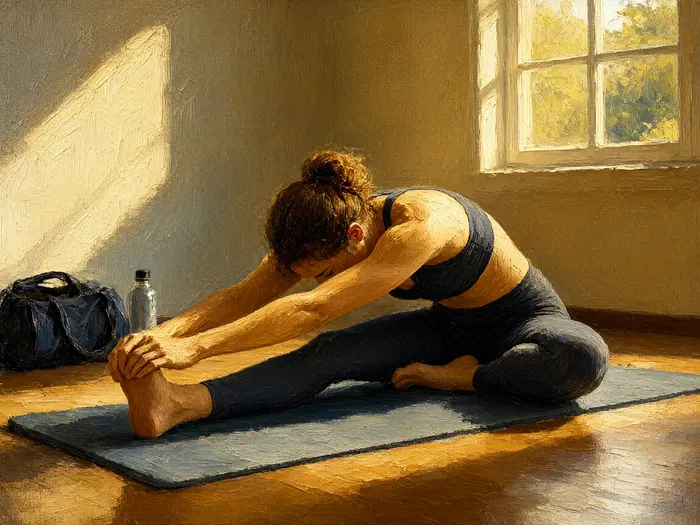
Stretch Hamstrings Seated With a Flat Back
Sit on the floor with one leg extended and the other knee bent, that foot out to the side. Square your pelvis, keep a long back, and hinge forward from the hip joints until you feel tension across the middle of the extended thigh — never in the spine or behind the knee. Loop a towel or belt around the foot if your hands fall short, and draw with the arms instead of rounding the chest. Hold 20 to 30 seconds per side, exhaling as you fold a fraction deeper, then switch legs — both hamstrings at once only works after you can keep the back flat.
 Howcompass
Open Quads Standing or From Your Side
Stand beside a wall or chair and rest a hand on it. Bend one knee and draw the heel toward the glute, keeping both knees pointing forward and close together; reach for the ankle, or loop a strap, belt, or towel around the foot if you cannot. Tuck your tailbone slightly under so the pull lands on the front of the hip and thigh instead of cramping the lower back. Hold 20 to 30 seconds per side, and if you stand unsteadily or your knees protest, do the same position lying on your side with the strap, which takes the balance demand away entirely.
 Howcompass
Release Hip Flexors in a Half-Kneeling Lunge
Kneel on a folded mat or cushion with one foot forward so the front knee stacks over the ankle at a right angle. Shift your weight an inch or two forward while gently tightening the belly and tucking the tailbone under; the sensation belongs in the crease at the front of the hip of the back leg, not in the lower back. That pelvic tuck is the whole trick — without it the stretch mostly takes up slack in the spine. Hold 20 to 30 seconds per side, and for a longer pull, raise the arm on the back-leg side overhead and lean away.
 Howcompass
Unload Glutes With a Figure-Four Stretch
Lie on your back with both knees bent, then cross one ankle over the opposite knee so the legs form a crossed-fours shape. Thread your hands behind the supporting thigh and draw it toward your chest until you feel a deep, dull stretch in the outer hip and glute of the crossed leg. Hold 20 to 30 seconds per side with your shoulders relaxed and your lower back flat on the floor; a seated version with the same crossed shape works in a chair. Stop if you feel sharp pain on the outside of the hip or any tingling running down the leg.
Part Two: Adductors, Chest, Lats, Neck
 Howcompass
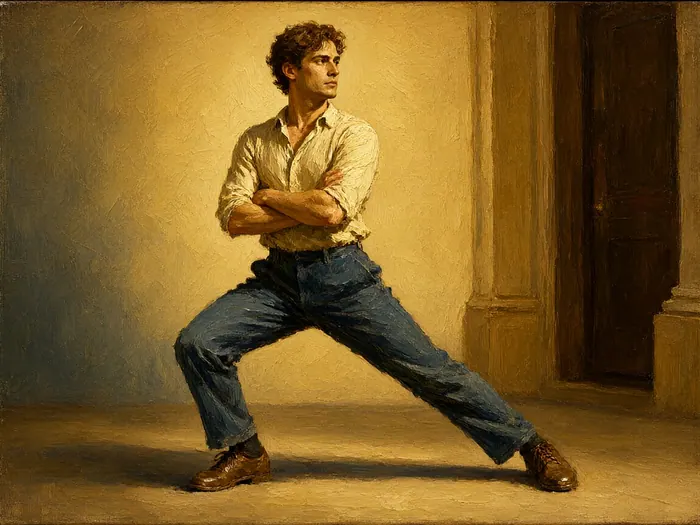
Ease Adductors With a Slow Side Lunge
Stand with a wide stance and both toes pointing forward. Shift your hips slowly to one side, bending that knee while the other leg stays straight, and keep your chest tall instead of folding at the waist; you should feel a pull along the inner thigh of the straight leg, held 20 to 30 seconds per side. A deeper option is the half-kneeling crouch: drop one knee sideways onto a cushion, keep the torso upright, and ease the hips forward an inch. Stop if anything pinches inside the groin — muscle tension here is expected, joint pain is not.
 Howcompass
Open the Chest in a Doorway
Stand in an open doorway. Place one forearm against the frame with the elbow at or slightly below shoulder height, and step through with the foot on that side until you feel a broad pull across the chest and the front of the shoulder. Hold 20 to 30 seconds per side, keeping the ribcage down and the neck long — arching your back borrows range your chest never earned. This is the most useful position in the sequence for anyone who spends the day rounded over a desk, a barbell, or handlebars, and it pairs well with the lat work next.
 Howcompass
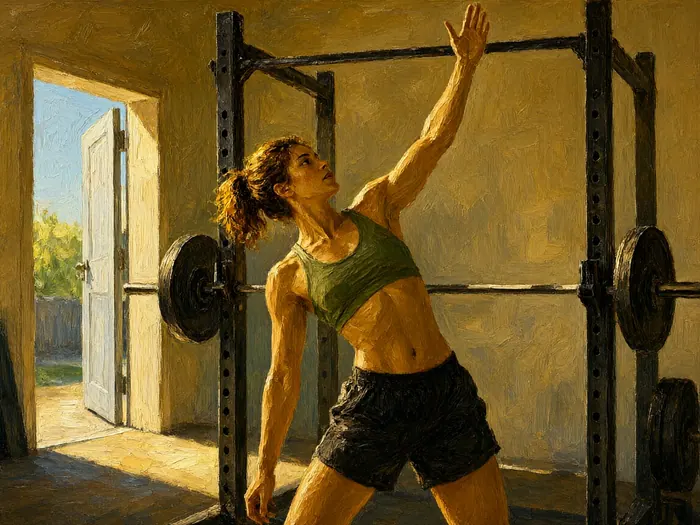
Pull a Lat From an Overhead Grip
Stand tall and reach one arm straight overhead, then lean the whole torso sideways away from it until you feel the ribs and the side of your back lengthen. For a stronger version, keep that hand pressed against a doorframe, a low bar, or a rack upright and walk your hips away instead of leaning. Hold 20 to 30 seconds per side with slow exhales, keeping both hips level. Lifters should not skip this position: the lat is loaded hard by deadlifts, pull-ups, and overhead pressing, and a tight lat shows up as a lower back that never stops arching.
 Howcompass
Settle the Neck and Upper Traps Gently
Sit or stand with a long spine and let one ear drop toward the same-side shoulder. Rest the hand from that side lightly on the top of the head — the weight of the hand only, never a push — and hold 20 to 30 seconds. For the upper trapezius, sit on one hand to anchor the shoulder down and turn the nose slightly down and away. No cranking, no forced rotation, no fast circles — stop immediately and see a clinician if you feel sharp pain, dizziness, or numbness or tingling running down an arm.
 Howcompass
Close With One Slow Breathing Minute
Finish seated, eyes closed or softly lowered. Breathe in through the nose for a count of four and out for six to eight for one full minute, letting the shoulders stay heavy. The long exhale is the lever that carries heart rate and breathing the rest of the way down, which is what the whole cooldown has been building toward. If one minute leaves you wired, extend it to three, or run the full version of this wind-down with our guide to progressive muscle relaxation, which works through every major muscle group before bed.
Adapt It to Your Training and Your Week
 Howcompass
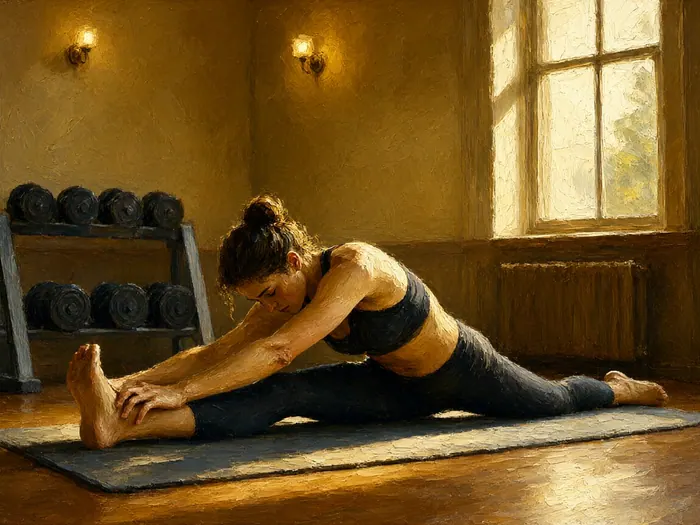
Scale the Routine for Running Days
On running days, add a second round on the four tissues that carry the mileage: calves in both knee positions, hamstrings, hip flexors, and the figure-four. Give those 30 to 45 seconds per side and cut everything else to a single 20-second pass so the total stays near ten minutes. Do the full sequence after long runs before you sit or drive for hours, when the hips would otherwise stiffen in the car seat. This cooldown slots directly onto the recovery habits in our 5K training plan without changing the week's shape.
 Howcompass
Scale It for Heavy Lifting Days
After lifting, stretch what you just trained, first. Quads and hip flexors lead on squat and lunge days; chest and lats lead on press and pull days; calves and the figure-four belong after any session with treadmill or jumps. Give those muscles 30 to 45 seconds per side and keep the remaining positions at 20. Long static holds before heavy work belong in the warm-up's place — do the full routine at the back of the session instead, the same sequencing rule we lay out in starting running and strength training safely.
 Howcompass
Add Foam Rolling to Safe Contact Points
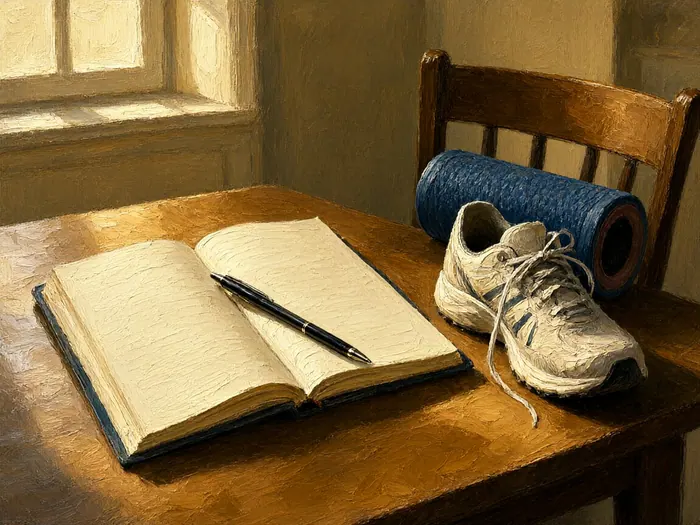
A firm foam roller is the active option, and it often feels better than passive holds. Spend 30 to 60 seconds per area, rolling slowly along the muscle belly and pausing on tender-but-dull spots: calves, quadriceps, outer glute, and the upper back supported over the roller. Safe contact points are muscle bellies — never press directly on the lower spine, the front of the hip joint, the kneecap, or a bruised area, and skip rolling entirely for 24 hours after any strain. The tool's basics are covered in this foam roller overview, and our guide to thoracic foam-roller extensions teaches the upper-back position in detail.
 Howcompass
Rehydrate and Refuel Inside One Hour
Do your stretches while you drink. Weigh yourself before and after training, then replace roughly 1.25 to 1.5 times that loss over the next few hours — about 16 to 24 fluid ounces per pound lost, close to half a liter per kilogram — in 200 to 300 milliliter servings rather than one enormous gulp. Add 15 to 25 grams of protein alongside carbohydrate within about an hour — milk, yogurt, a shake, or a banana with peanut butter — so repair starts while your range is still improving. The American Council on Exercise keeps practical hydration guidance for hot and long sessions.
 Howcompass
Put the Cooldown on a Weekly Schedule
Flexibility work pays out on a schedule: at least two to three days a week for maintenance, and daily is better — the US physical activity guidelines echo the same two-plus-days message. The practical version is the full ten minutes after every workout you actually do, three to five sessions a week for most people, plus one short five-minute pass on a rest day, or a 10-minute morning stretch on days you did not train, so the holds never go stale. Log one line per session — date, positions, tightest muscle — and review the four-week trend rather than any single day.
How to know it worked
- Your breathing and heart rate are back near resting within ten minutes of finishing the routine.
- You felt distinct but mild tightness in at least six of the nine positions, and pain in none.
- After four weeks, your seated hamstring reach and figure-four depth are visibly greater than in week one.
- You drank to replace sweat loss within the hour after hard sessions and stayed pale-yellow hydrated through the day.
- You ran the cooldown after at least two out of every three workouts last week — including the days you did not feel like it.
Common mistakes to avoid
- Going straight to the floor cold, skipping the 3 to 5 minutes of easy movement, then wondering why the holds feel pointless.
- Bouncing, or pushing on the head with the hands to force a deeper neck stretch.
- Holding your breath and grinding to the end of the timer through sharp pain.
- Stretching the muscle you strained today because it feels tight — that tightness is the injury guarding, not shortness.
- Only ever stretching the favorite position instead of working the whole list and repeating the tightest muscle to a 60-second total.
Frequently Asked Questions
Question: Do I really need the full ten minutes after every workout?
After an easy or short session, the three-to-five-minute wind-down plus a single pass on the muscles that feel tight is enough. Keep the full ten — wind-down and all nine positions — after long runs, hard intervals, and heavy leg days, when your heart rate needs the gradual drop and the hips and calves tighten hardest. Consistency across the week matters more than any single day.
Question: Why not just stretch cold before the workout instead?
Two reasons. Warm muscle with high blood flow lengthens more easily and safely, so the post-workout window gives you more range per second of hold. And long static stretches done immediately before strength or sprint work can briefly reduce force output, so start your session with dynamic movement and easy reps, then move these 20-to-30-second holds to the end where they belong.
Question: Is 20 to 30 seconds per stretch actually long enough?
Yes for this purpose. The ACSM's standard prescription falls in roughly the 10-to-30-second range per rep, repeated two to four times until each muscle accumulates about 60 seconds of total hold. This routine's 20-to-30-second-per-side pass lands in that window, and adding one extra round on your tightest muscle gets you to the 60-second target whenever the clock allows.
Question: Will this routine stop next-day muscle soreness?
Not reliably. The research on post-exercise stretching shows only a small effect on delayed-onset soreness, so the honest claims are better range of motion, a calmer breathing-down, and a clean end-of-session ritual. Soreness fades mainly as you repeat and progress loads gradually. For measurable recovery, prioritize sleep, fluid, and refueling before adding extra holds.
Question: Should any of the stretches hurt?
No. The target is a pull of tightness or mild discomfort, never sharp or stabbing pain. Ease off and reposition — taller chest, shorter range — and if pain persists at an easy hold, skip that muscle today and watch it. A stretching ache that fades as you breathe is normal; pain that makes you brace, wince, or change your stance for the next day is not.
Question: Is foam rolling better than static stretching?
They are different tools, not rivals. Brief rolling gives strong sensory input and can make a calf or hip feel looser faster for a short window, while held stretches are the proven route to lasting range. A sensible hybrid is 60 seconds of rolling on the griest area followed by the static sequence, always on muscle bellies rather than joints, spine, or bruised tissue.
Question: What if something clicks or goes numb during a stretch?
Stop that position for the day. A single painless click as a joint settles is usually unremarkable, but any click with pain, pins and needles, numbness, or weakness tracking down a limb means backing off and seeing a clinician if it lingers more than a few days. Do not keep stretching to prove it was nothing — nerve and joint symptoms are a different category from tight muscle.
Tips
- Build the out-breath longer than the in-breath in every position; that, not depth, is what makes the hold feel productive.
- Always take the bent-knee half of the calf stretch — the straight-knee version skips the soleus, which carries hill running and heel-raised lifting.
- Anchor the cooldown to a fixed cue: it starts the moment you rack the last set or cross a finish line, before you check your phone.
- Loop a towel or belt around your foot for hamstring and quad holds instead of hauling with your hands and rounding your back to compensate.
- Keep one line per session — date, positions run, tightest muscle — so your weekly schedule is based on a log rather than optimism.
Warnings
- Do not stretch an acute strain. A pop or tear during training, sharp pain in one spot, swelling, bruising, or true weakness means that muscle rests: skip it, use gentle compression and 15 to 20 minutes of ice for the first day or two, and see a clinician if pain or swelling has not eased within a few days or you cannot bear weight.
- Never bounce into a stretch and never crank the neck with your hands or force rotation. Sharp pain, dizziness, or numbness or tingling down an arm or leg during neck positions means stop immediately and get clinical review.
- Do not hold your breath or chase pain. A stretch that hurts is over-stretching — stay at tightness or mild discomfort, breathe continuously, and remember that grueling holds build nothing that a calm minute does not.
- Get urgent medical care for chest pain or pressure, an irregular heartbeat, unusual breathlessness, fainting, or one swollen, warm calf during or after exercise. Those are not cooldown problems, and no routine of stretches fixes them.
Things You'll Need
- Sturdy step or stair edge with a handrail
- Open doorway with a clear frame
- Wall or chair for balance in standing stretches
- Yoga mat or folded cushion for kneeling
- Strap, belt, or towel for quad and hamstring reach
- High-density foam roller, 12 to 18 inches long
- Phone interval timer set to 20-30 seconds
- Water bottle, 500 to 750 milliliters
- Electrolyte tabs for long or sweaty sessions
- Fast post-workout protein: milk, yogurt, or a shake with 20 grams
- Banana or cereal bar for the carbohydrate half of refueling
- Bathroom scale for pre- and post-training weight checks
- Towel to sit on so floor stretches stay comfortable
- Small notebook or notes app for the four-week log
Related Howcompass Guides



References (5)
- ACSM's Guidelines for Exercise Testing and Prescription — flexibility programmingAmerican College of Sports Medicine
- How to Stretch After ExercisingNHS
- Stretching: Focus on FlexibilityMayo Clinic
- Exercise and Physical Activity TopicsHarvard Health Publishing
- Physical Activity Guidelines for AmericansU.S. Department of Health and Human Services
Further reading
- StretchingWikipedia
- Foam RollerWikipedia
Encyclopaedia entries are background, not evidence: no step below rests on one of these.
Sources are listed so you can read the underlying guidance yourself. Our editorial policy explains how guides are reviewed.
Did this article help you?
0 readers found this helpful — add your vote.
No comments yet — be the first to share your results.