How to Build a Capsule Wardrobe That Lasts
A guide to Auditing Your Lifestyle and Existing Clothes, Selecting Comfortable, Coordinated Core Pieces, Testing Outfits and Filling Genuine Gaps, Caring for the Wardrobe and Reviewing It Seasonally
A capsule wardrobe is not a rigid list of thirty fashionable items; it is a coordinated collection that makes your ordinary mornings easier. Use this 20-step process from our Personal Care and Style collection to begin with what you already own, prioritize comfort and repair, and keep garments in use—a principle also central to the circular textiles economy.
How do you build a Capsule Wardrobe That Lasts?
 Howcompass | How to Build a Capsule Wardrobe That Lasts
Auditing Your Lifestyle and Existing Clothes
HowcompassLog every outfit you wear for one week
Track the clothes you actually wear for one ordinary week. Note the activity, weather, outfit, comfort, and why you reached for each item, without changing your habits to make the exercise look impressive. Include work, home, exercise, social plans, and practical outerwear so the final wardrobe reflects your life rather than an idealized itinerary. Repeat the week again before each thirty piece seasonal capsule rebuild.
 3Howcompass
Write down your dress codes and hard limits
Define your dress codes and non-negotiable practical needs. Write down workplace expectations, religious or cultural requirements, mobility needs, sensory preferences, local weather, and how often you do laundry. These constraints are the foundation of the capsule; a beautiful item that fails one of them will remain unworn. More planning ideas live under personal care and style guides.
 Howcompass
Pick a flexible palette from worn favorites
Choose a flexible color palette from your existing favorites. Pick two or three easy-to-combine base colors and a small number of accent colors or patterns that already appear in your most-worn pieces. Hold candidates together in daylight and keep shades you enjoy wearing; palette rules should support your choices, not force every garment into beige, black, or navy. Shoot the daylight pairs using the light tips in take better photos.
 Howcompass
Sort every garment by category and condition
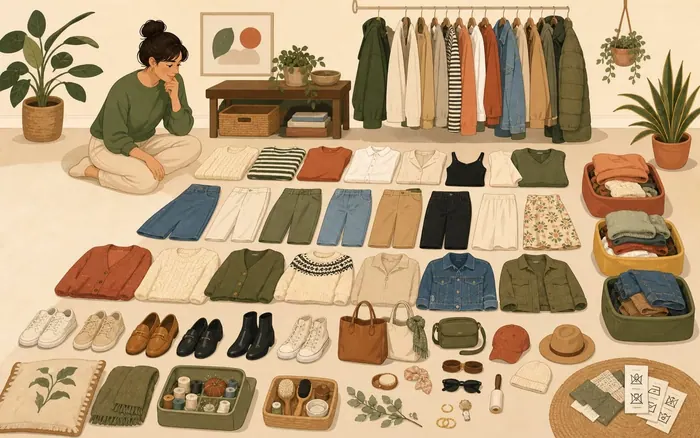
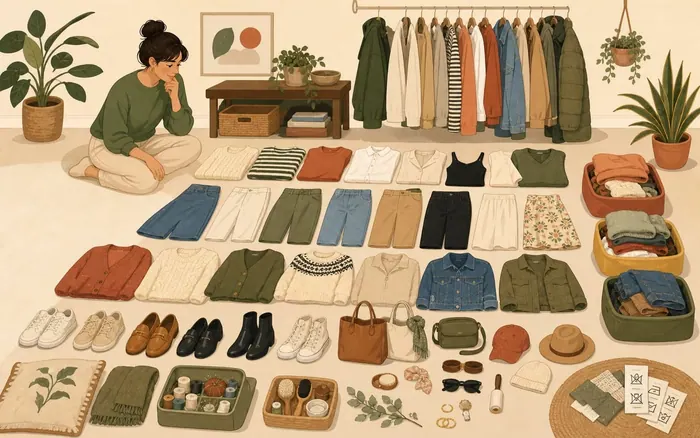
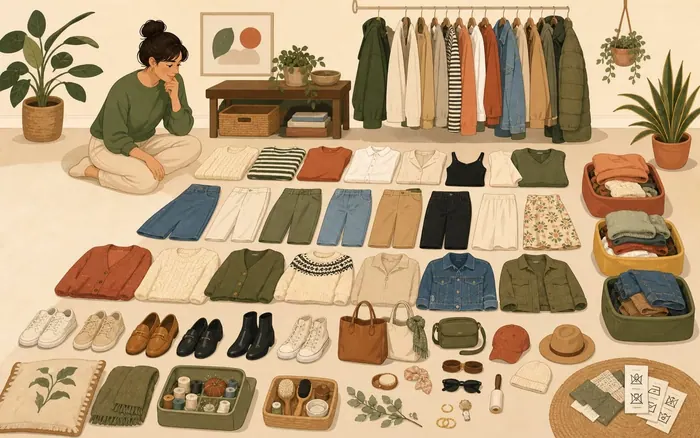
Inventory every garment by category and condition. Lay out tops, bottoms, layers, dresses, outerwear, shoes, and accessories, then sort them into regular use, occasional use, repair, cleaning, and responsible rehoming piles. Check pockets, closures, hems, stains, fabric labels, and fit before deciding that something has reached the end of its useful life. Keep the condition notes beside your capsule wardrobe plan file.
 Howcompass
Set a realistic wardrobe size range
Set a working wardrobe range instead of chasing a magic number. Estimate how many outfits you need between laundry days, then allow for climate changes, special occasions, and items with distinct practical roles. Treat the resulting range as a review tool rather than a quota; the goal is enough coordinated choice with as little unused duplication as practical. A two week travel wardrobe shows how few pieces one routine needs.
Selecting Comfortable, Coordinated Core Pieces
 Howcompass
Photograph your three most-worn outfits
Build the core around your three most-worn outfits. Photograph these outfits and identify their shared features, such as a preferred trouser shape, sleeve length, fabric weight, or level of formality. Keep those reliable combinations accessible and use them as the reference point for every later addition instead of starting with a generic internet checklist. Use the framing basics from take better photos for those shots.
 8Howcompass
Move through a full range before you decide
Test fit and comfort through a full range of movement. Sit, bend, reach overhead, climb stairs, and walk for several minutes while checking waistbands, shoulder seams, armholes, hems, and shoe pressure points. Set aside pieces that could be improved by a tailor or cobbler, and do not keep an uncomfortable item merely because it matches the palette. Warm up first with a 10 minute morning stretch so you move naturally.
 Howcompass
Match each core top with two bottoms
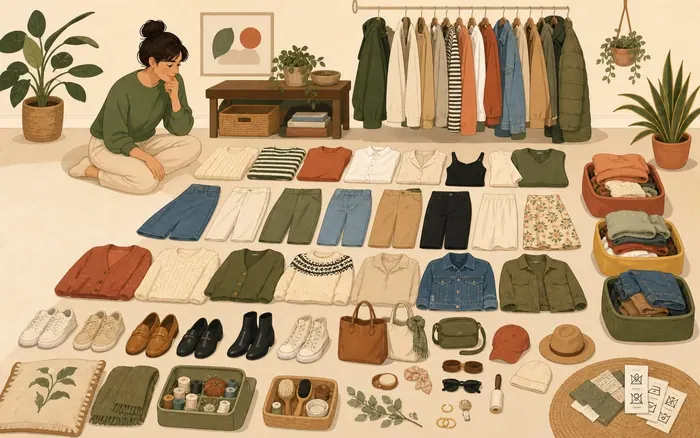
Coordinate tops, bottoms, and layers through repeated combinations. Aim for each core top to work with at least two suitable bottoms and each layer to fit over the intended shirts or knitwear without pulling. Dresses and one-piece outfits can fill several roles when a jacket, belt, or different shoes changes the context comfortably.
 Howcompass
Choose fabrics your climate and laundry can handle
Match fabrics and layers to your climate and care capacity. Include breathable warm-weather options, insulating mid-layers, rain protection, or thermal basics where your routine requires them, and check whether their care instructions fit your time and equipment. A garment that needs specialist care can still belong, but its upkeep should be a deliberate choice rather than a surprise. Learn pressing shirts and trousers before you commit to delicate fabrics.
 Howcompass
Give every pair of shoes a clear job
Assign shoes and accessories to clear functional roles. Cover your normal walking distances, workplace, weather, and formal needs with comfortable pairs, then use belts, scarves, jewelry, or bags to add variety without crowding the wardrobe. Check that every accessory works with several outfits and does not interfere with safety, mobility, or daily comfort. The same rotation logic applies to a carry-on wardrobe of shoes.
Testing Outfits and Filling Genuine Gaps
 Howcompass
Photograph ten complete outfits before shopping
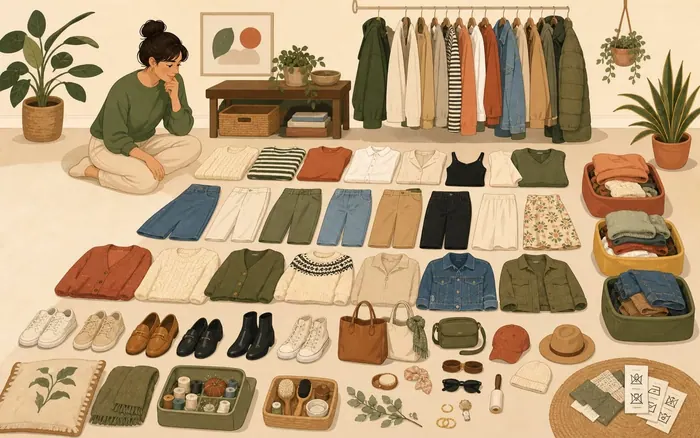
Assemble and photograph ten complete outfits before buying anything. Include shoes, layers, and necessary accessories in each photograph, and label combinations for their intended activity or weather. This visual index exposes repeated gaps and gives you practical options on rushed mornings; adjust the target upward or downward to suit your own routine. File the shots using organize digital photos habits so the index stays usable.
 13Howcompass
Wear-test new combinations on ordinary days
Wear-test the new combinations on ordinary days. Notice whether fabrics bunch, layers overheat, colors feel unlike you, or shoes become uncomfortable after several hours, and record small adjustments in the outfit index. A combination that looks balanced on a hanger is only successful when it remains practical through the day. Update your capsule wardrobe plan with what the day revealed.
 Howcompass
Repair and clean promising garments first
Repair and clean promising garments before replacing them. Reinforce loose closures, mend small seams, remove suitable stains, and ask a professional about alterations or shoe repairs where the construction justifies it. Use our guides to sew on a coat button and remove knitwear pilling for two common fixes.
 Howcompass
Turn gaps into a ranked shopping list
Turn the remaining gaps into a prioritized shopping specification. Describe the exact role, color, size, fabric, comfort requirement, care limit, and budget for each missing item, then rank the list by how many planned outfits it completes. Leave speculative purchases and duplicate statement pieces off the list until the core wardrobe has been tested for several weeks. Give the ranked list a home in your monthly budget before any sale tempts you.
 Howcompass
Try each candidate against three owned outfits
Evaluate every candidate slowly before committing to it. Try it with the intended layers, move as you did during the fit test, read the care and fiber labels, and mentally build at least three realistic outfits with clothes you already own. Consider durability, alterations, return terms, and likely frequency of use; a low cost-per-wear estimate cannot rescue an item you are already unsure about. Cross-check a pricey find against your personal budget first.
Caring for the Wardrobe and Reviewing It Seasonally
 Howcompass
Arrange the capsule so options stay visible
Organize the finished capsule so every option is visible. Group similar categories together, place everyday pieces at accessible heights, and leave enough space for fabric and closures to avoid unnecessary crushing. Use shelf dividers, broad hangers, or folded stacks according to the garment's construction, and keep the outfit photographs somewhere easy to consult. Fold and roll like you would for packing a suitcase so nothing crushes.
 Howcompass
Follow the care label instead of a habit
Follow each garment's care label rather than a universal washing rule. Empty pockets, close vulnerable fasteners, separate colors and delicate items as directed, and avoid hotter or more aggressive treatment than the label permits. The FTC care-label guidance explains the purpose of these instructions; airing and resting garments between wears can also reduce unnecessary cleaning when they are fresh and dry. Smooth the clean pieces with pressing shirts and trousers on low heat.
 19Howcompass
Dry knitwear flat and reshape it damp
Wash and dry knitwear according to its fiber and construction. Check whether machine washing, hand washing, or professional care is specified, reshape damp knitwear gently, and dry it flat unless the care claim permits another method. Follow the Woolmark drying guidance and our detailed tutorial on hand-washing wool and cashmere for delicate knitwear.
 Howcompass
Clean and inspect items before seasonal storage
Rotate seasonal pieces with a cleaning and maintenance check. Wash or dry items as appropriate before storage, ensure they are fully dry, repair damage, and store them in a clean, dry, ventilated space suited to the material. While changing seasons, inspect footwear and use our leather-boot care guide when the product instructions recommend conditioning or shoe trees.
 Howcompass
Review the capsule each season and adjust
Review the capsule every season and change one gap at a time. Use your outfit log to identify unworn items, repeated comfort problems, and genuine replacement needs, then repair, alter, rehome, or recycle through suitable local options rather than automatically discarding. Keep the system flexible as your body, work, climate, and preferences change; a lasting wardrobe is maintained through attention, not preserved by strict rules. The review works better if you keep a weekly review journal of outfit notes.
Frequently Asked Questions
Question: How many items should a capsule wardrobe contain?
There is no universal correct number. Start with enough coordinated outfits for your laundry cycle, climate, work, and special needs, then adjust after a few weeks of wear logs rather than removing useful clothes to reach a target.
Question: Do all my clothes need to be neutral colors?
No. Neutrals can simplify coordination, but accents, prints, and favorite colors work well when they repeat across several outfits. Build the palette from combinations you already enjoy wearing.
Question: Should I discard everything that does not fit the capsule?
No. Begin by separating the capsule from storage rather than rehoming immediately. Repair useful pieces, retain legitimate occasional or sentimental items, and make disposal decisions only after the new combinations have been tested.
Question: Do I have to get rid of clothes I love but never wear?
Not automatically. Keep a small keepsake rail or a memory box for pieces you wear at most a few times a year, and leave them out of the counted capsule so they do not distort your outfit planning. Revisit that box once or twice a year and move anything you still have not worn on to rehoming or resale.
Tips
- Keep one small section outside the capsule for sentimental, formal, sports, or safety clothing so practical exceptions do not undermine the whole system.
- Photograph outfits in consistent daylight and include the shoes; incomplete outfit pictures hide some of the most useful coordination clues.
- When shopping, carry a written description and, if practical, the garment you want the new item to match rather than relying on memory.
Warnings
- Never ignore a garment's care label because a general fabric guide recommends a different washing or drying method.
- Do not store damp clothing or use sealed plastic for long-term textile storage unless a conservator or manufacturer specifically recommends it for the item.
- Donation is not a guarantee that clothing will be reused; research local collection and recycling options and avoid dumping unusable textiles into charity streams.
Things You'll Need
- One-week clothing and activity log
- Full-length mirror and a camera or phone
- Hangers, folded-storage space, and shelf dividers
- Basic sewing kit and fabric-care tools
- Outfit-gap list and a realistic budget
- Garment-care labels and suitable detergent or storage supplies
Related Howcompass Guides



References (5)
- PART 423—Care Labeling of Textile Wearing Apparel and Certain Piece GoodsU.S. Government Publishing Office (eCFR) — Federal Trade Commission rule
- Caring for Wool — washing, drying, and long-term garment careThe Woolmark Company
- How to Dry Wool — flat drying and care-label exceptionsThe Woolmark Company
- A New Textiles Economy — durability, use, and circular designEllen MacArthur Foundation
- Fashion Collection — five centuries of dress, construction, and accessoriesVictoria and Albert Museum
Sources are listed so you can read the underlying guidance yourself. Our editorial policy explains how guides are reviewed.
Did this article help you?
0 readers found this helpful — add your vote.
No comments yet — be the first to share your results.