How to Make Chore Charts Kids Actually Follow
A guide to List the Real Work Before You Draw Anything, Build a Chart Your Children Can Read, Teach It Once, Then Let the Chart Do the Asking, Handle Pushback, Fairness, and the Inevitable Stall
Most chore charts fail for the same reason: they are a wish list written by a tired adult rather than a description of work a child can actually finish. The tasks are vague, the standard is invisible, the timing assumes grown-up speed, and the reward is whatever the parent remembers to offer that night. A child looks at the board, cannot tell whether making the bed means pulling the blanket up or rebuilding hospital corners, and does the version that takes 20 seconds. Then the chart becomes a source of nagging, and nagging becomes the chart. The fix is a system, not a bribe. Write down every task that repeats in your house and time it. Sort tasks into what belongs to one person and what belongs to everyone. Give each child two or three jobs that match what their hands can do at their age, show them what finished looks like in a photograph, and run one short family window where everybody works at the same time. When a job gets missed, let the ordinary consequence land instead of a lecture. Those five moves do more for cooperation than any sticker ever has. Two cautions up front. Money and contribution should stay on separate tracks, because paying for daily tasks teaches a child that help is a transaction and that unpaid help is optional. And screen-based rewards backfire more often than they work: making tablet time the wage for chores turns the thing you want to limit into the prize and makes the chore its price. This guide covers the chart, the check-in, the pushback, and how to take the scaffolding off on purpose once the habits are running.
A chore chart holds when it shows real tasks a child can finish inside one 15-minute family window, with a picture for every job, a definition of done, and a reward calendar meant to disappear. Start by timing 35 to 55 recurring household tasks, then hand each child 2 to 3 age-matched jobs: pick-up tasks at 2 and 3, table and laundry work at 6 to 8, a bathroom or a dinner at 13 and up. Put a dry-erase board at child eye level, teach each chore in three guided rounds, rotate shared jobs every two weeks, and let natural consequences handle misses. Keep money off the daily chart.
- Time
- 40 minutes to plan, then one 15-minute reset window a day
- Cost
- $40-$75: dry-erase board, markers, laminating pouches, a visual timer
- Difficulty
- Beginner setup, three weeks of consistent follow-through
- Works on
- Families with children ages 2 to 18, one child or four
- Not for
- Screens as daily payment, chores as punishment, or unpaid labor disputes
- Results
- Unprompted reset windows usually appear between week 3 and week 6
How do you make Chore Charts Kids Actually Follow?
 Howcompass | How to Make Chore Charts Kids Actually Follow
List the Real Work Before You Draw Anything
HowcompassWalk Each Room and Write Every Recurring Task
Before a chart exists, spend 30 quiet minutes with a notepad and walk the house room by room. Write down every task that repeats on a schedule, including the invisible ones: bins rolled out on collection night, the coffee grinder rinsed, pet bowls, hand towels swapped, plants watered, shoes straightened at the door. Most families land between 35 and 55 recurring jobs, and only 8 to 12 of those should belong to children. Word each item the way it repeats, such as empty the dishwasher every morning, because a chart of one-off jobs produces one-off help. You cannot choose a fair share until you can see the whole load, and seeing it is usually the moment a parent stops feeling guilty about asking.
 Howcompass
Time Each Task With a Real Kitchen Timer
Run each job once with a timer and write down the honest number instead of a guess. Unloading a dishwasher takes most adults 5 to 7 minutes, wiping a table about 3, a full bathroom scrub 12 to 15, and sweeping a kitchen floor 6. Then plan on a child needing two to three times that, because children work in bursts, stop to inspect things, and lose the thread halfway. Two rules fall out of the timings: any single job that takes an adult more than 20 minutes is too big for one line on the board, and one child's daily list should stay under 15 minutes total. A chart built from timed numbers is a chart a child can win.
 Howcompass
Sort Tasks Into Family, Personal, and Occasional Piles
Split the list three ways. Family jobs belong to the household and rotate: trash, recycling, vacuuming the hallway, resetting the table after dinner. Personal jobs belong to one person and never rotate: their bed, their laundry, their dishes carried to the sink, their school bag packed for tomorrow. Occasional jobs happen on a Saturday, maybe twice a month: fridge shelves wiped, window tracks, baseboards, a car interior. A workable split for most houses is roughly 60 percent personal tasks, 25 percent family tasks, and 15 percent occasional ones. That sorting matters more than the design of the chart, because almost every argument starts when one child realizes they have been doing another person's personal job for three weeks.
 Howcompass
Match Each Task to a Real Age Range
Work in brackets instead of waiting for readiness. Ages 2 to 3: put wipes and diapers into the bin, carry a plastic plate, put three toys in one box, hand you clothespins, two or three minutes at a time. Ages 4 to 5: pull the blanket up on their own bed, set placemats, wipe a spill with a damp cloth, put clean socks in a drawer, water one plant from a small cup. Ages 6 to 8: feed the pet from a measured scoop, empty small wastebaskets, match sock pairs, carry in two grocery bags, run a bath towel to the hamper. Ages 9 to 12: load and unload the dishwasher, vacuum their room, take out trash and recycling, make a stove-free breakfast. Ages 13 and up: run a full laundry cycle, scrub a bathroom, cook one dinner a week; for that last one, start with Teach Kids Kitchen Safety and Knife Skills With Soft Foods so the first solo meals are safe ones. HealthyChildren.org's guidance from the American Academy of Pediatrics on age-appropriate chores for children makes the same point: start early with simple tasks, expect improvement rather than perfection, and add responsibility as school years pass.
 Howcompass
Write a Definition of Done for Every Chore
Write one line per task that states the finished condition, with no more than four checks. Bathroom sink: no toothpaste on the mirror, towel hung straight, hair out of the drain, cloth rinsed and back on its hook. Bedroom: floor clear of clothes, books stacked, blanket pulled to the rail, bin empty. Tape the line where the work happens rather than only on the central board, and photograph one genuinely finished example to keep as the reference. Without a written standard, an eight-year-old's honest effort looks like laziness to you and the inspection becomes an argument about opinion instead of a comparison against four checks they can read themselves.
Build a Chart Your Children Can Read
 Howcompass
Pick the Chart Format Your Family Will Keep
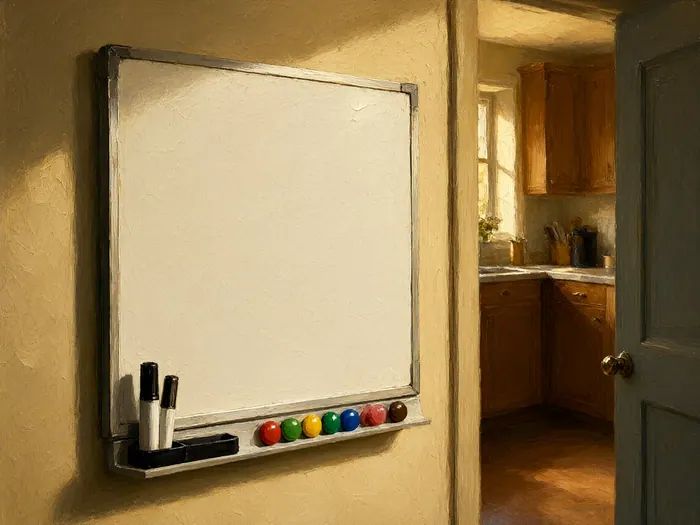
Three formats work. A 24-by-36-inch dry-erase board mounted at child eye level costs $25 to $45, survives a school year, and reads from across the kitchen, which is why it beats the alternatives for families with children under 9. A printed paper chart is free and better for 2- and 3-year-olds who need to physically move a piece, but it dies within three weeks unless it lives inside a clear sleeve you can wipe with a cloth. Chore apps suit 9 and up, who can self-check without a parent holding the phone, and backfire for younger children because the reward then lives inside the device you are trying to limit. Whatever you choose, put it in a room every person crosses at least twice a day, and consult AAP's 5 C's of media guidance before making an app the center of the system.
 Howcompass
Give Every Pre-Reader a Picture of the Job
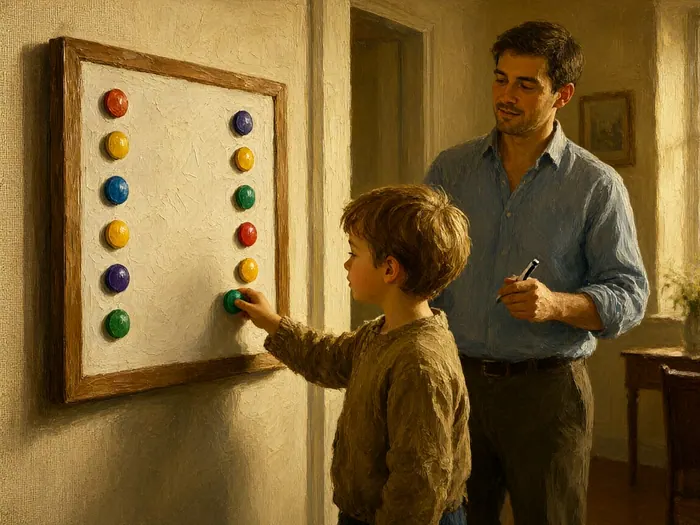
Children who cannot read yet cannot follow a word list, so photograph the job instead of naming it. Take 25 to 30 phone pictures around your house: their own bed made, their own bin, the exact hook their towel goes on, one photo per finished state. Print them roughly 2 inches square, run the sheet through about $8 of laminating pouches, and stick a hook-and-loop dot on the back of each. Your child pulls the picture off the board and presses it into the finished column, which turns a chore into a matching game worth repeating. Real photographs of your own rooms beat cheerful clipart, because the child recognizes the actual bed rather than a generic one.
 Howcompass
Choose Fixed or Rotating Assignments Before You Start
Settle this before week one, because it is the hardest rule to change later. Keep personal tasks fixed all year: no child should have to wonder whether today's laundry is their job. Rotate family tasks on a visible cycle, usually a two-week swap announced at the Sunday meeting, so nobody is permanently assigned the toilet. Cap the shared pool at 4 to 6 tasks, and split any job a child refuses into two smaller lines rather than handing the whole thing to one person. Rotation has a second payoff: by spring, every child in the house has vacuumed a room, scrubbed a sink, and carried the recycling to the curb, which is the actual point of the chart.
 Howcompass
Set One 15-Minute Family Reset Window
Choose one window at the same time every day, often 4:30 pm after a snack or 6:45 pm before dinner, and let the timer be the cue instead of a parent's voice. Everyone works at once on their own two or three tasks while the same short playlist runs, then the family walks the rooms together for the final 2 minutes to compare against the definition cards. For 4- and 5-year-olds, run 10 minutes and stop while they still want more. Add one 30-minute Saturday window for family jobs. Batching is what makes the load feel light: one announced window replaces eight small demands spread across an evening, and it is the demands that wear families down. Predictable time plus predictable order is the core of Build Happy Family Routines That Stick.
 Howcompass
Anchor Each Chore to Something That Already Happens
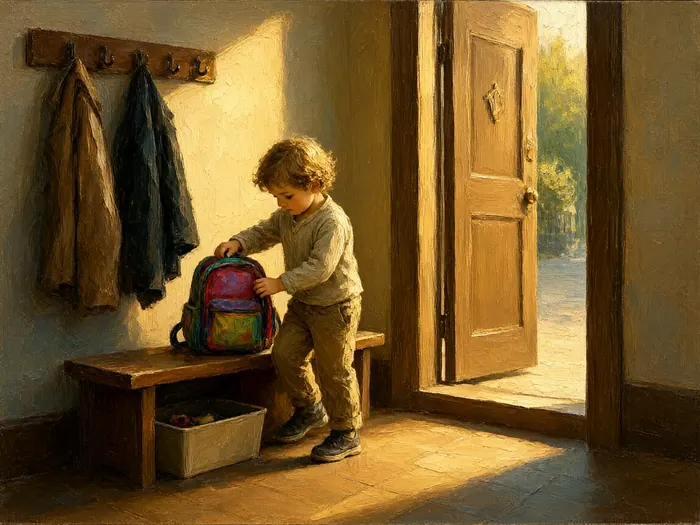
Attach every new task to something already happening in the house, because an anchored habit needs no reminder. Shoes and backpacks go to the entry drop zone the second the door closes, and that one rule deletes three lines from the board; our Set Up a Mudroom Entryway Drop Zone for Backpacks and Shoes guide covers the hooks, bins, and labels that make it stick. Plates go to the sink before any screen turns on. A wet towel goes on the hook before pajamas go on. Clean clothes land in the hamper before breakfast. Add one anchor per week: installing four at once is the usual reason a relaunch has stalled by Thursday.
Teach It Once, Then Let the Chart Do the Asking
 Howcompass
Teach Each Chore in Three Guided Rounds
Teach a task once, in three rounds, and you will not have to teach it again this year. Round one: you do the job slowly in front of your child and narrate four or five short steps, about 4 minutes. Round two: you work side by side, both hands on the same cloth, same length. Round three: they do it alone while you leave the room and come back to compare against the definition-of-done card. Budget 20 to 25 total minutes per chore, once, and expect the load to feel heavy for the first two chores and quick by the fifth. Skipping these rounds and expecting competence to follow an instruction is the most common reason a chart goes quiet after ten days.
 Howcompass
Use a Visual Timer and a Two-Part Transition Script
Children surface slowly out of absorbed play, so give the ending a shape they can see. A sand timer or a $15 visual countdown timer shows time shrinking without anyone saying a word. Then use one warning and one bridge: five more minutes, then shoes to the rack, and after that we build the tower together. Name what comes next rather than only what stops, and give two warnings instead of one for children who find shifts hard. The CDC's Essentials for Parenting Toddlers and Preschoolers makes the same argument about predictable routines and clear expectations. Keep the wording identical every day, because a familiar sentence is understood faster than a fresh one.
 Howcompass
Describe the Effort Instead of Judging the Result
Say what you saw rather than scoring it: you got the four corners of the sink, the towel is straight, the cloth is back on its hook. Description tells a child exactly what to repeat, while generic praise teaches them to wait for your reaction. If the job is genuinely not done, walk past it in the moment and mention at the weekly meeting that the sink needs its second pass tomorrow morning. Redoing a task in front of the child who just attempted it teaches that the real standard is yours and their effort was rehearsal. HealthyChildren.org is blunt that praising a child's effort in each task, not the outcome, is what keeps young children willing to contribute.
 Howcompass
Separate Money Lessons From Household Contribution
Run two lists and say the difference out loud once. The contribution list holds daily personal and family tasks and stays unpaid, because everyone who lives here contributes, which includes parents doing their own share without paying themselves. The money list holds occasional extra jobs a child 9 or older can finish unsupervised: washing the family car for $6, sweeping a garage for $8, hauling a week of firewood for $5, cleaning the fridge shelves for $10. If you give an allowance, keep it independent of the daily chart so one bad week does not erase the money lesson and so help never becomes a transaction. For a teenager with a summer job, our Budget Your First Part-Time Wage walkthrough is the natural next conversation.
 Howcompass
Hold a 10-Minute Weekly Family Check-In
Put 10 minutes on the calendar, usually Sunday after breakfast, and ask three questions in this order: what worked this week, what got stuck, what should we swap. Every child gets one swap vote, including a 4-year-old, and you write the decision on the board so the change does not live only in your memory. Hold the line at 10 minutes for families with children under 8 and allow 15 once teenagers are in the room. The meeting is where complaints get an actual hearing, which is how you stop litigating at 6:47 on a Tuesday evening, and it is where you will notice an uneven load before anyone explodes. The same short structured format works between adults, as Hold a Weekly 20-Minute Relationship Check-In explains.
Handle Pushback, Fairness, and the Inevitable Stall
 Howcompass
Answer Not Fair Without Opening a Debate
When a child announces that this is not fair, answer once with the principle and then return to the work. Fair means everyone in this house does unpleasant jobs and everyone takes a turn at the toilet; it does not mean identical lists, because a 4-year-old cannot carry a recycling bin down steps. Then point at the board instead of at your authority and ask what their line says. Refuse mid-task renegotiation, and write the complaint down for Sunday's meeting, where it gets a real hearing and possibly a swap vote. Long explanations in the moment read as a debate that might be won, and the next refusal will be longer and louder than this one.
 Howcompass
Let Natural Consequences Do the Quiet Teaching
Choose consequences that follow logically from the missing task, announce them in advance, and apply them without commentary. No uniform in the hamper means the shirt is washed in the sink that night or goes to school wrinkled. The trash missed its window means the bag waits by the door until next collection and nobody wheels it back. The pet went unfed means the bowls get filled together right now, before the game starts. Keep consequences small, boring, and pre-announced, and never attach them to food, a school trip, a birthday, or time with you. CDC's Essentials for Parenting Teens frames the same idea for older kids: clear expectations and calm, consistent follow-through teach responsibility better than escalation does.
 Howcompass
Build a Reward Calendar That Fades Out
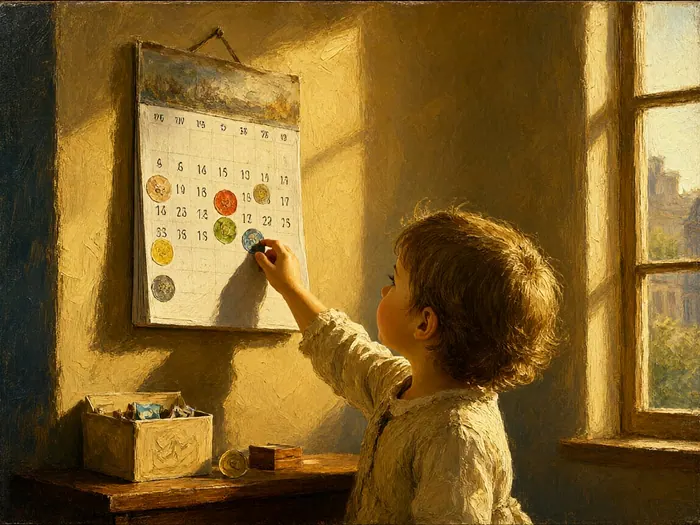
Treat the reward calendar as scaffolding, and plan its removal on day one. Ages 2 to 5 need same-day marks, so a sticker goes on right after the reset window and that evening's reward is a choice rather than a purchase. Ages 6 to 8 can work toward Friday, typically 10 marks for a small outing or $3. Ages 9 and up move to a weekly tally traded for something bigger. Then fade deliberately: stretch the interval from daily to three days, then to weekly; swap the object for a privilege such as picking Saturday dinner; then drop the calendar for one chore and keep it for the rest. Token economies are faded by exchanging tokens for natural social reinforcement, which is what a working chart does over 8 to 12 weeks. Keep screens off the prize list: the AAP's free Family Media Plan tool helps you agree on media rules separately, so tablet time never becomes the wage for taking out the trash.
 Howcompass
Diagnose the Stall and Change Only One Thing
Charts usually stall between week two and week four, and the symptoms tell you which single thing to fix. Nobody looks at the board means it is in the wrong place, too high, or buried under old magnets. Every finished job gets argued means the definition of done is missing or runs longer than four checks. Refusal at the window means the list is too heavy, so cut to two tasks per child for a week. You are doing all the reminding means the chore is not anchored to something that already happens. Change one variable, run seven days, then reassess at the meeting. Rebuilding the whole system in week three is how a good board ends up in a closet.
 Howcompass
Relaunch on Monday Without a Lecture
Pick a Monday, strip the board to three chores per child, and restart without a postmortem. Say the plan changed rather than that they failed: we are starting over with fewer jobs, and I will teach the bathroom one more time on Sunday. Do round one again for the single hardest task, put the picture cues back at child eye level, and make Friday's small reward easy enough that somebody earns it by day four. Name your own part out loud too, because a skipped meeting or a forgotten anchor is usually half of the stall. A repair that includes the adult's piece keeps a reset from becoming a shame speech, and the shame version is the part children remember for years.
How to know it worked
- Each child can name their own two or three tasks and how long each takes, without looking at the board.
- The reset window starts on the timer alone at least four days out of seven, with no adult reminder.
- Inspections compare against a written definition of done instead of an argument, and finished jobs pass on the first check most of the time.
- At least one shared task has rotated hands twice without a protest about fairness.
- The reward calendar has been extended to a longer interval, or one chore has come off it entirely, while the work still happens.
Common mistakes to avoid
- Writing the tasks you wish existed instead of the ones you timed, so a five-minute job becomes a 30-minute battle.
- Leaving the definition of done unwritten, then judging the result by your own invisible standard.
- Paying for daily contribution chores, which converts household membership into an hourly job and ends cooperation the day you stop paying.
- Doing all twelve reminders yourself and concluding the chart does not work, when the missing piece was an anchor and a visual timer.
- Adding every task in week one and holding nobody to the Sunday meeting, so the system carries no feedback loop.
Frequently Asked Questions
Question: At what age should a chore chart start?
Around 2, with two-minute pickup tasks, since toddlers work beside you rather than from a list. Add a picture-based board at 4 or 5 with one or two jobs, and a written board around 6 to 8, when reading makes self-checking possible. The American Academy of Pediatrics notes that preschoolers can start pitching in with simple tasks and that skills improve over time, so the chart follows the child.
Question: Should chores be tied to an allowance?
Keep the daily chart unpaid and give an allowance, if you give one, on a separate track. Paying for routine contribution teaches children that help is a transaction and that unpaid help is optional. If you want a money lesson, sell occasional extra jobs to children 9 and up, such as a $6 car wash or an $8 garage sweep, which are real work bought at a real price.
Question: My child refuses to start the reset window. What now?
Shrink the ask until starting is boring. Cut the list to one task, walk over together, set a 5-minute visual timer, and say what comes after. Then teach that one chore in three guided rounds the same day, because refusal is often a cover for not knowing the finished standard. If refusals are daily and intense across every routine, mention it to your pediatrician rather than adding more rewards.
Question: Are chore apps better than a dry-erase board?
For children 9 and older, an app can help because it tracks tallies and lets a kid self-check without a parent holding the phone. Under about 9, a physical board wins: it is visible to the whole family, it costs nothing per use, and nothing on it glows or suggests the next video. Apps fail when the reward is screen time, since that makes the tablet the wage for housework.
Question: How do I stop myself redoing my child's work?
Write the standard so redoing is not your judgment. Tape the four-check definition where the work happens, compare against it out loud, and if a spot fails, note it for tomorrow's window instead of wiping it now. Watching a parent immediately fix finished work teaches children that their effort was practice and that the real bar is invisible. It also quietly tells them you will do it eventually.
Question: What if my children are close in age and one gets an easier list?
Say the difference out loud and let the older list grow. Fair in a family means everyone has hard jobs and everyone contributes, not that the lists match, because a 5-year-old cannot scrub a toilet. Show the rotation schedule so each child knows which unpleasant job reaches them, and take fairness complaints to the weekly meeting where a swap vote is possible. Ability differences shrink within a year.
Question: How long should the reward calendar stay in place?
Plan for 8 to 12 weeks, then fade it deliberately rather than waiting until it stops working. Stretch the interval first, daily to three days to weekly, then trade objects for privileges such as choosing Saturday dinner, then drop the calendar from one chore while keeping it on another. Marks tied to effort and consistency disappear entirely once the reset window has run on its own for two straight weeks.
Tips
- Put the board where the family already stops, not where it looks tidy: a hallway or kitchen wall read from three feet away beats a refrigerator door nobody faces.
- Keep two markers and erase the board together on Sunday night. A blank board with fresh magnets signals a new week better than any speech.
- Photograph the done standard for the three most-argued jobs. A picture of the actual made bed settles a disagreement faster than a description.
- Run the reset window at the same time for 21 days before judging the system. Almost every chart that fails was abandoned in week two.
- Say thank you for a contribution with no chart attached, like carrying a sibling's laundry up the stairs. Unpaid help named out loud is the behavior you are actually building.
Warnings
- Do not make screen time the daily wage for chores. It turns the activity you want to limit into the prize, makes housework its price, and cooperation usually collapses the week you take the device away.
- Never tie chores to food, a school trip, a birthday, medical care, or time with you. Consequences should be small, logical, boring, and announced in advance.
- Stop adding tasks once a child's daily list passes about 15 minutes of work. An overloaded list produces refusal, then a fight, then a chart in a drawer.
- If a child cannot manage any routine task without significant distress, or if the household has to escalate daily to get cooperation, raise it with your pediatrician rather than assuming laziness. Some children need a different scaffold, not more stickers.
Things You'll Need
- 24-by-36-inch dry-erase wall board
- Wet-erase markers, one color per child
- Round magnets or magnetic clips
- Home printer and laminating pouches
- Hook-and-loop dots for picture cues
- Smartphone for photographing finished tasks
- Visual countdown timer or sand timer
- Small daily sticker sheet
- Child-height hook rack and entry bins
- Kids-sized dustpan and broom
- Two-section laundry hamper per child
- Lightweight 4-gallon wastebasket
- Caddy with a personal cloth and spray bottle
- Notebook for the Sunday family meeting
Related Howcompass Guides




References (6)
- Age-Appropriate Chores for ChildrenHealthyChildren.org (American Academy of Pediatrics)
- Kids & Screen Time: How to Use the 5 C's of Media GuidanceHealthyChildren.org (American Academy of Pediatrics)
- AAP Family Media PlanHealthyChildren.org (American Academy of Pediatrics)
- Essentials for Parenting Toddlers and PreschoolersCenters for Disease Control and Prevention
- Essentials for Parenting TeensCenters for Disease Control and Prevention
- Resources for Families | Learn the Signs. Act Early.Centers for Disease Control and Prevention
Further reading
- Token economyWikipedia
Encyclopaedia entries are background, not evidence: no step below rests on one of these.
Sources are listed so you can read the underlying guidance yourself. Our editorial policy explains how guides are reviewed.
Did this article help you?
0 readers found this helpful — add your vote.
No comments yet — be the first to share your results.